Der Müde Tod (The Weary Death), aka Destiny, considered Fritz Lang’s first great German masterpiece of the silent movie era by many, also marked the beginnings of a new chapter in the development of his cinematic career. In retrospect, it can be seen as the overture to a portentous phase in German film culture that looked, in the early-1920s -- at least as far as the rest of Europe was concerned – like producing a domestic rival to the dominating grandeur of the Hollywood machine, with Lang at the very centre of the phenomenon. This was the start of a period when the country’s epic film creations were being conceived on an ever-grander scale, as though aiming to overawe audiences with elaborate, fantastical, overarching visions of society as a vast hub of interconnecting mythic spectacle, obliquely threatened by the creeping chaos of industrial modernity. Indeed, this cinema’s brand of romance, melodrama and adventure-escapism seemed frequently quite unable to elude those constant codified references to the trials of the age spawning them. Lang’s contribution is, of course, synonymous with the period: in conjunction with the many technical specialists employed by the recently expanded UFA studios after its merger with Erich Pommer’s Decla-Bioscope, Lang and his professional and personal partner, Thea von Harbou, achieved some of the most richly imagined, densely realised visions of the day on the vast soundstages of the ‘Neubabelsberg’ complex – insulated from, and often oblivious to, the political and economic convulsions of the Weimar Republic and its social repercussions, as they raged in the streets beyond the studio perimeter.
The sequence of films Lang made in the wake of Der Müde Tod produced great work that seems as compelling and imaginative today as ever, despite, and sometimes because of, the antiquity of the methods utilised or invented by the director in bringing them to the screen. Although he lived a somewhat sybaritic lifestyle, at one remove from the uncertainties and indignities of the economic turmoil the rest of Germany was at the time being subjected to; and financially protected by the bubble of immunity his recent commercial success (and the critical acclaim which had come with it) afforded him, Weimar’s extremes and excesses continued to provide Lang with endless amounts of new material to be habitually harvested from newspaper headlines and worked, at a later date, into the feverish, elaborately structured plots that so compelled both himself and von Harbou in this, the couple’s most creative period of artistic collaboration.
The position Der Müde Tod occupies at the vanguard of this narrative, in which Fritz Lang’s artistic ascendancy parallels the increasing sophistication of the German film industry’s production methods, largely emerges in retrospect. Upon its initial release, in October 1921, the film was considered to be something of an artistic failure by many German critics, playing for only two weeks in Berlin after opening at several of the city’s most prestigious luxury theatres. The general consensus among critics at home was that the fantasy and swashbuckling content of a 'traditional' Fritz Lang picture had been overburdened here by a certain air of pretentiousness born of Lang's attempt to imbue the material with a philosophical profundity it was not capable of sustaining, and which the film overall did not truly possess. Its extravagant symbolism and allegorical content served only to confuse, bogging the story down rather than opening it up to wider imaginative possibilities. However, the film's reception throughout the rest of Europe could not have been more in contrast to these dismissive readings of its worth in Germany. In countries such as Britain and France, it was universally praised for the originality of its content, the boldness of its imagination, and the impressiveness of Lang’s execution of the material. As Lang’s biographer Patrick McGilligan has noted, Der Müde Tod would become a famous example of 'a German motion picture rejected in Germany itself that was given a second chance at home on the strength of rhapsodic foreign notices.'

Up until this point, Lang’s success in Germany had been built on the back of a series of pictures that mixed melodrama and heroic adventure with a taste for offbeat pseudo-science leavened with a dash of Oriental mysticism -- elements rooted in Lang’s childhood love of pulp fiction and penny dreadful crime literature. Both he and von Harbou shared an enduring appreciation for the work of the prolific German author Karl May, whose adventure novels were usually set in a mythical Old West, or else would contain exotic and unrealistic depictions of the Orient or of the Middle East. As a young man, soon after leaving his native Vienna, Lang developed a great passion for exotic cultural artefacts and folk art belonging to foreign or “primitive” cultures, including paintings, statues and masks from China, Japan or Polynesia. According to his own accounts and those of the colleagues and contemporaries who often visited the couple at home, the apartment he later shared with von Harbou became a virtual museum dedicated to this interest in foreign exotica. Von Harbou’s office included among its treasures Lang’s cherished ‘cabinet of the thousand delights’; and the first thing a visitor would see upon entering the couple’s apartment was the director's personal collection of shrunken human scalps!
Lang’s early solo screenwriting work for Erich Pommer and Joe May, as well as the earliest movies he directed from this period such as Des Spinnen (The Spiders), came replete with decorative elements inspired by the orientalist trappings for which this genre of literature was to become notorious. These early screenplays and films of Lang’s feature doomed romances and stolen Inca treasure hoards aplenty and are led by athletic yet intelligent (and bookish) German adventuring heroes who are invariably to be found exploring hidden underground cities or discovering exotic lost civilisations; not to mention the secret criminal fraternities dedicated to world domination that are so often two-a-penny in fictional worlds such as this.
After Der Müde Tod all of these elements would inform Lang’s cinema for as long as he continued working in Germany, but the sophistication of the techniques increasingly being brought to bear on the narrative structures deployed in von Harbou’s screenplays meant that there needed to be corresponding developments in the film grammar Lang was using to translate them onto the screen. These developments were occurring just as Erich Pommer’s Decla-Bioscope was being merged with UFA to create the biggest and most sophisticated machine for movie production outside of the Hollywood studio system. Lang’s cinema from Der Müde Tod onward came to be associated with a unique melding of low art and grand vision: in Lang's cinema, pulp cliché worked harmoniously alongside poetic craft, somehow facilitating a greater existential heft than had been evident in any of his previous work. When Der Müde Tod was re-released in Germany in the wake of its fantastic reception elsewhere in Europe, it played for weeks and catapulted Lang into the upper echelons of UFA’s filmmaking elite. The film became the cornerstone on which Lang's subsequent reputation for synthesizing spectacle-based entertainment with existential profundity was to be built.

Der Müde Tod is an anthology picture made up of three separate narratives, each set in wildly diverse historical and geographical contexts but thematically linked by a phantasmagorical framing story. This dreamy linking tale contrasts the content of the other stories, exemplifying a poetic and aesthetic tone much in keeping with the sense that German culture had reached a crux point after WW1 wherein traditional Romanticism could now be blended with pre-war forms of Modernism in art. The results of this visual concoction anticipate the look and feel of F.W. Murnau’s Nosferatu (released the following year in 1922) and explore the fantastical escapist mythical-medievalist landscapes of Faust (1926), five years before that big-budget UFA film became Murnau’s last film made in Germany. Elements of Expressionism are heavily in evidence for the first time in Lang’s cinema during this picture, which also marks Lang’s introduction to the genius cinematographer Fritz Arno Wagner. An important and innovative cameraman who worked on two of the most visually resplendent stories in Der Müde Tod, Wagner's distinctive style was later to become synonymous with cinematic Expressionism: a form of visual stylisation later to be incorporated into Hollywood’s conception of the Gothic Horror and Noir film genres when Germany's best directors and technicians, having been forced to flee their homes after the Nazi takeover, wound up working on many such films in America. Wagner would go on to shoot several of Lang’s best German films, including M, and he was involved with many of the greatest German movies and directors of the silent era, such as F.W. Murnau (Wagner photographed Nosferatu) and G.W. Pabst. Wagner is said to have been one of the few among Lang’s close collaborators who could tolerate the director’s sometimes harsh and dictatorial ways. In this first piece of work together they manage to develop some genuinely innovative techniques for shooting 35mm film in low-light conditions, experimenting with reflective images in mirrors, and capturing the mingling of light and shadow on the dappled water surfaces of a studio-constructed Venice by night.

The film opens on a country road near a crossroads. Here the pale, monk-like figure of Death -- personified as a wispy-haired, heavy-browed man in black – boards a coach occupied by a youthful couple who are in love and en route for a quaint, rustic German hamlet situated across the next bridge. The film is pitched in a non-realist register existing somewhere between allegorical dream-space, legend and fairy tale. It is a tone suggested by Lang’s exacting use of poetic language in the opening credits and in the first few intertitles. Described as ‘a German Folk Song in Six Verses’, the cast list for the following framing story describes the events depicted as taking place ‘somewhere, sometime’; and the opening intertitle sets the unreal scene by describing the crossroads, the little town, and by extension the young couple heading towards it, as being ‘lost in a valley, as if in a dream’. This fatalistic, melancholic storybook tone is further reinforced by a description of autumn leaves which are said to [be] ‘falling like tears’.
Despite the film sporting a credit identifying Fritz Lang as both writer and director, in reality, Thea von Harbou was involved with drafting the script from its conception. It undoubtedly displays many of the elaborate storytelling traits she had first begun using in her several previous collaborations with Lang, as evidenced by the film’s sophisticated use of framing devices; its flashbacks and occasional digressions; and its concertina-like manipulations of time and space. Lang first met von Harbou while they were both working on projects for the producer-director Joe May. Aristocratic in bearing and privileged in upbringing, she was, by all accounts, precociously talented from a tender age and fully emancipated by early womanhood -- which is when she began earning a living in theatre and as a writer in post-war Berlin. But Thea von Harbou was also supremely nationalistic, becoming especially more so with the onset of World War 1. Her novels were known for the patriotic sentiment underpinning their mythic subject matter: they dealt in Germanic legends recalibrated as allegorical celebrations of sacrifice to the glorious Fatherland and would take on a much darker meaning later, when von Harbou fully embraced the doctrine of Nazism.

Though not a medium she had ever previously been particularly interested in exploring, the world of cinema began to fill more and more of von Harbou’s creative life after her discovery that May had optioned one of her novels for adaptation. Soon after, she landed a job writing original scenarios for Joe May’s production company, May-Film GmbH, and her ensuing relationship with Lang, both creative and personal (after she divorced the actor Rudolf Klein-Rogge, von Harbou and Lang became one of Weimar Germany’s premier celebrity couples) would secure her controversial position in film history, even though, during the 1920s, she was destined to become one of German cinema’s most celebrated writers thanks to other collaborations with titans such as F.W. Murnau, Carl Dreyer and E.A. Dupont. Early on, Lang and von Harbou found that they shared many interests, including a connoisseurship of Karl May’s fiction and a love of foreign cultures. The director had planned on adapting von Harbou’s 1917 novel Das indische Grabmal (The Indian Tomb), but the project was ‘stolen’ away from him by Joe May, who, believing the property destined to be a success, determined to direct the film himself! When Lang finished his partnership with May and returned to Erich Pommer, he brought von Harbou with him to Decla-Bioscope, and the couple worked on several more projects there, Lang bringing more and more sophistication to his filmmaking craft with each new release. Der Müde Tod finally crystallised itself as the purest expression of a theme that, despite von Harbou’s involvement in it, made this film a deeply personal project for Lang -- perhaps one of the most personal he ever conceived.
This is a film about the existential tragedy that dwells at the core of human existence: the knowledge possessed by each of us that our lives are ultimately circumscribed by the inevitability of our own demise. It’s a dramatisation of the tension between fate and free will, and an examination of the struggle to find purpose and meaning in a world that can seem cold and indifferent to personal suffering. Despite adopting the guise of a romantic allegorical fable, and seeking to entertain with poetic flights of the imagination that deliver many moments of adventure, intrigue, comedy and exotic fantasy, the conclusion it reaches is far from comforting: life is nothing without the struggle to find and hold onto love, but love is always doomed from the first moment of inception.

This potentially maudlin approach to the film's subject was inevitably informed by Lang’s personal circumstances: his mother had died in 1920, while Lang was on an arduous shoot in the Bavarian Alps filming Das wandernde Bild (The Wandering Image). At the time, the director had felt unable to curtail filming so that he could attend the funeral. But of even more shocking significance was the recent death by apparent suicide of Lang’s first wife, Lisa Rosenthal, which probably occurred (although almost everything about the event is shrouded in mystery) at around the time when Lang and von Harbou were prepping for Der Müde Tod, between late-1920 and early-1921. Lang claimed to have found his wife’s dead body in the bath, the victim of a fatal gunshot wound to the chest. Only a matter of hours before the incident she had walked in on her husband and Thea von Harbou to find the couple sharing an illicit moment of intimacy. Lang’s own revolver – a Browning automatic, retained from his service during WW1 – had apparently fallen from her hand and was found on the floor at the side the bathtub. However, there was never a full and official police inquiry into the matter, and all record of the incident had disappeared from Berlin police files when researchers later attempted to look more closely at the circumstances surrounding the tragedy. Lang had made many enemies on his way to becoming Germany’s most acclaimed film director; some of them, like the cinematographer Karl Freund, always believed that he had been directly responsible for Lisa Rosenthal’s murder, either pulling the trigger himself or else deliberately neglecting to attain medical assistance until it was too late to save her. Whatever the truth of the matter, it is hard to ignore the coincidence that the heroine of Der Müde Tod is also distinguished by her willingness to contemplate suicide for the sake of love -- a feature that plays a significant role in the development of a plot which involves the young woman entering a shadowy candle-lit netherworld suspended outside of chronological time, in the moment between life and a possible death, where she confronts the personification of Death himself as part of an attempt to rescue her lover from his realm.
The idea of presenting Death in a human form, as an entity who is capable of interacting with mortals and bargaining with them for the souls of their loved ones (much imitated since on film, most notably in Ingmar Berman’s The Seventh Seal) was a stroke of conceptual inspiration that, according to Lang, was also rooted in a personal experience: a childhood dream Lang experienced while in the throes of a fever, in which he imagined seeing a dark stranger in a wide brimmed hat approach his bed by moonlight with outstretched arms, as though the figure were about to lead him away. This description provided the model for actor Bernhard Goetzke’s portrayal of Death as a sepulchral spectral entity, weary of his eternal role in human affairs and desperate to be relieved of it. The trauma of this vision gave Lang, in his own somewhat melodramatic words “[a] complete understanding of the ecstasy which made martyrs and saints embrace death”. The experience was a formative one, and, he claimed, “a love of Death, compounded of horror and affection, stayed with me and became a part of my films.”
Yet the one event towering above all others as the central influence on the film’s morbid and melancholic obsession with the fragility of human existence must be Lang’s first-hand experience of combat during the First World War. This surely is also the reason the film came (eventually) to resonate with contemporary German audiences so widely; they belonged to a generation only too familiar with the great sacrifices the young had recently been called upon to make in that conflict which had plunged Germany into chaos at home. The Great War is, of course, the one event that dominates critical responses to a remarkable set of innovations distinguishing Germany's cinema during the Weimar period, foremost amongst them being its turn toward the art movement Expressionism, which came to be seen as a convenient visual marker and shorthand for the internal psychological turmoil of the individual. But this was a picture made by a director who came out of this terrible conflict as a decorated war hero; who signed up for the Austro-Hungarian Army in January 1915 and reached the rank of second lieutenant by October of that same year; and who now liked to run his film sets like he was a commander who'd been placed at the head of a vast army of conscripts.
Lang had been caught up in the initial excitement marking the early months of the war, entering into the fighting with zeal and with a spirit of the whole thing being a big adventure. His experiences, though, prefigure those encountered by the characters in this film: they start off full of hope and expectation for the future but end up possessing only the knowledge that death is the one inescapable certainty awaiting them. Lang had been assigned to a reconnaissance patrol involved in fighting the Russian army on the Eastern Front; he was decorated for bravery and courageousness many times, but also injured on several occasions as the fighting became more brutal and the position of the Austro-Hungarians more desperate. He was promoted to lieutenant in 1916, having had his horse shot out from under him when a mortar shell exploded nearby, and it was while on leave, recovering from damage to his eye caused by shrapnel (which may have been responsible for Lang adopting the famous monocle he wore for the rest of his life), that he first started writing script scenarios for Joe May. However, in the latter stages of the war, a fatigue and weariness set in and the director later described his experiences of the battlefield horrors he encountered during 1918, as having shown him “life stripped to its rawest: hunger and desperation and death.” In his biography of the director, McGilligan writes how death now became for Lang like ‘an old acquaintance, a sobering reality, not an abstraction.’

This is the background to a picture that takes Lang’s love of adventure fiction, as well as an interest, shared with Thea von Harbou, in the mythologies of various foreign lands, in particular India -- the story owes some debt to the Indian mythological tale of Sati Savitri, which is about a princess who brings her husband back from the dead by outwitting the Indian god of Death -- and combines them in a richly realised portmanteau piece, revelling in visual excitement and diverse aesthetic wonders. The film’s look prefigures the joint influences of Romanticism and Expressionism that would also find an outlet in the mise-en-scene of Murnau’s Nosferatu, released the following year. To bring about this, his most ambitious work yet, Lang worked closely with the Decla production design and art directing team of Robert Herlth, Walter Röhrig and Hermann Warm. The director was also acting as his own editor and augmenting the sumptuous and stimulating set designs of his team with any number of innovative in-camera special effects of his own devising.
Both Röhrig and Warm had been involved in helping Walter Reimann create the jagged, exaggerated abstract landscapes so famously painted onto the walls of the Decla studio for the filming of Robert Wiene’s Das Kabinett des Dr Caligari. Warm would later work with Carl Theodor Dreyer on The Passion of Joan of Arc and Vampyr, re-creating that unique tonal nexus (situated somewhere between realism and fantasy) which turns up first, here -- in Der Müde Tod. The film’s vividly detailed evocation of a unusual and exotic collection of fantastical locations -- the pastoral medievalist idyll on which the film settles during the opening framing story; Death’s sombre walled-off Cathedral-like realm, haunted by its ghostly spectres and the looming flicker of shadows; and the historical settings seen in the film’s three love story segments: ninth century Bagdad, Renaissance Venice, and a fabulist fairy tale version of Middle Kingdom Imperial China -- are conjured for the screen by the designers with an astonishing attention to detail and brought to life through beautifully designed costumes and make-up. Some elements of the aesthetic look seem to prefigure the fantasy Gothic of Murnau’s 1926 film Faust, which was also designed by the team of Röhrig and Herlth.

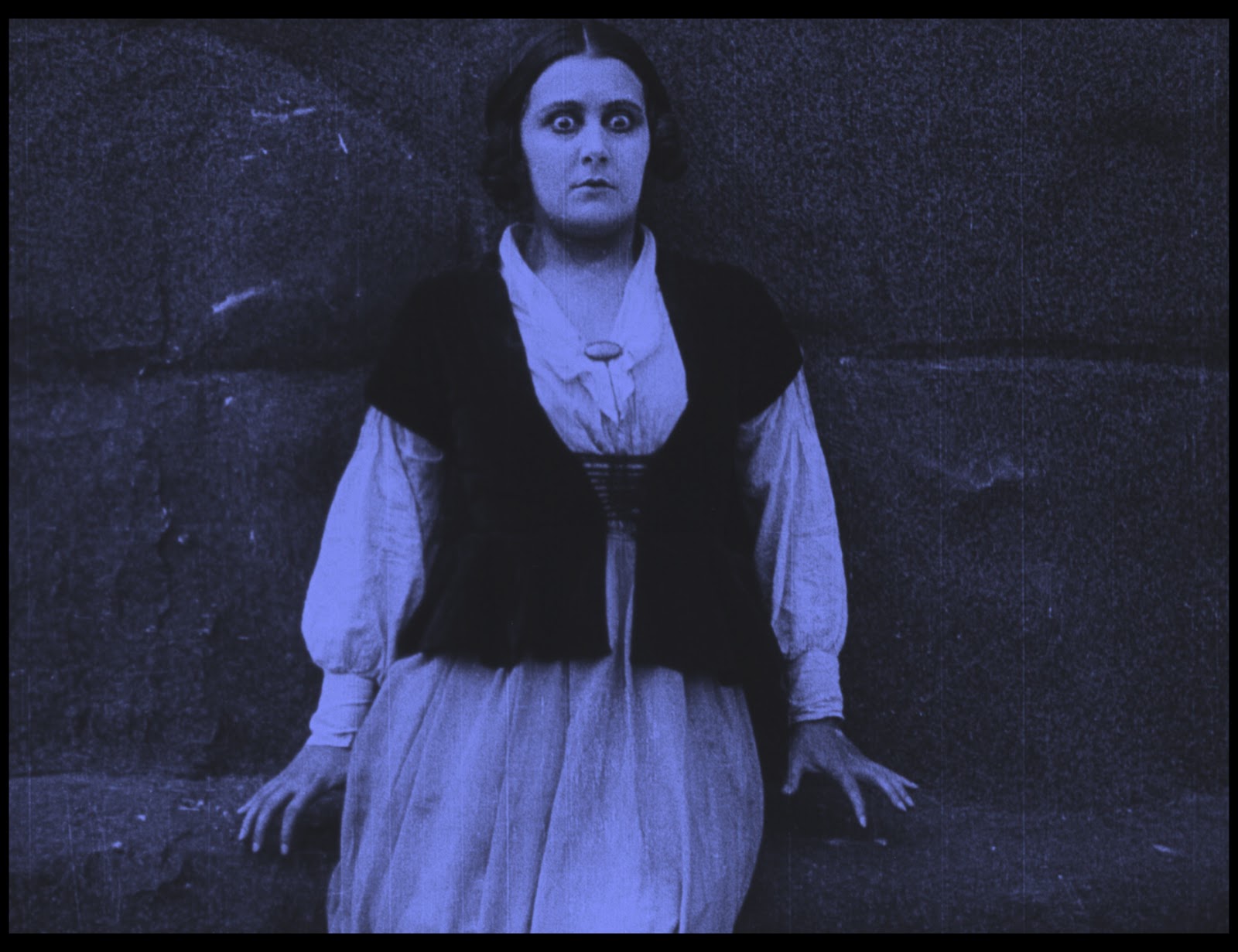
The film starts in naturalistic mode. In anticipation of Murnau’s Nosferatu, we open on a coach journey that presents us with daylight exterior shots of countryside locations. Not long after, Goetzke’s cloaked Death figure materialises at a crossroads marked by a crucifix (via what looks like a double-exposed image of a firework explosion), hitching a lift with the stage-coach carrying our love-struck protagonists, who take the form of a recently engaged couple played by Lil Dagover and Walter Janssen. The travelling partners cross a tiny bridge leading to a rustic village, and we are almost immediately exposed to a sense of this enclosed space’s heightened unreality: the town square -- built on the lot at Decla’s Babelsberg Studio, and first seen via an elevated long-shot that accentuates the centrality of the clock tower -- displays a certain quaintness, an old-world charm that feels meticulously designed to appear both artificial and archaic. The town’s central inn, the Golden Unicorn, introduces us to a rich collection of auxiliary characters who have little relevance to the main storyline but who provide some amusing Dickensian satirical colour, before introducing a flashback explaining the cloaked stranger’s curious relationship with the town. Here we learn that the weary figure has come here to retire and cultivate his own private garden; the bibulous, unworldly, gluttonous town dignitaries have been only too pleased to accept a handsome sum for selling him the plot of land previously reserved for extending the neglected local cemetery, but are nonplussed when they learn that the stranger has had the entire area surrounded and sealed off with an impenetrable stone wall that is too high to scale and has no discernible points of access or ingress. Ominously, it appears that Death has now made his permanent home in this otherwise tranquil area of bucolic seclusion.
Flashback scenes depicting Bernhard Goetzke’s gaunt but imposing stranger, shrouded entirely in black, visiting his newly purchased property – all crumbling arches and overgrowing ivy – whilst a gravedigger prepares to inter yet another ‘customer’ nearby, cannot but help lead one’s thoughts to the story of Dracula, which, of course, in both its original novel form and in the numerous film adaptations that have followed, also hinges on the Count moving to a new land -- England -- on the pretext of having recently purchased the derilict Carfax Abbey. When we cut back to the present goings on inside the inn and immediately witness this dark figure steal away the soul of bland paramour Walter Janssen from under the very nose of his beleaguered fiancée (the couple having just shared the ill-omen of spilling some wine whilst attempting to drink together from the bridal cup), we’re inclined to see this personification of Death in the same light (or should that be moonlight?) as Stoker’s now famous vampire creation: a malign, evil force, preying on the vulnerabilities of the unsuspecting and the uncomprehending. Such inclinations are re-enforced by the macabre overtones (soon to be associated forever with depictions of the Gothic on film) underlying the images and scenarios presented to us in the immediate aftermath of this bewildering supernatural event: distraught, and almost delirious in her grief, the young girl stumbles through the darkening town and, in her emotionally receptive state, witnesses a procession of transparent ghostly figures drifting zombie-like towards the edifice constructed by the stranger, then disappearing through its solid stone walls … one of them being her fiancé. She then falls into the orbit of a wizened old apothecary who’s out digging for unusual-looking roots on a nearby hillside in the dead of night, and winds up being taken back to his shadowy cluttered shop where a phrase from a verse in the Song of Solomon stands out in the pages of an open Bible -- ‘love is stronger than death’ -- tempting her into poisoning herself so that she may be joined with her lover in the afterlife.

This segment of the film is particularly suggestive of the fantasy Gothic mode. Those strange, misshapen nocturnal landscapes amid which the bereaved girl flounders as somnambulating spirits drift by, were artfully created and constructed in the controlled environment of a studio to imply the appropriately saturnine state of bewitchment and delirium; while the old apothecary’s shop – indeed the old apothecary himself – is depicted by Lang as looking strange and crooked and redolent of an exaggerated form of theatricality. What occurs next in the narrative is a piece of conceptual alchemy that barely registers on one’s initial viewing, yet does something unexpectedly radical with the film’s depiction of time, identity and the chronology of events in order to have the story ‘jump tracks’ for the next hour, continuing on a new, unidentifiable metaphysical plane that folds most of the rest of the film into a single second of narrative time. It’s possible to argue that the very possibility of a surrealist form of cinema was created with this daring conceit, for it even has echoes in something as recent as the sequence from the penultimate episode of David Lynch and Mark Frost’s Twin Peaks: The Return, in which time seems to become arrested at a certain juncture in the main narrative, and an entirely new timeline (possibly) establishes itself to appear as if superimposed on a frozen moment of the ‘present’. It shouldn’t be surprising then that this film also made such a strong formative impression on Luis Bunuel, who has cited Der Müde Tod as a prime influence on his approach to filmmaking.
The moment of rupture occurs just after Lil Dagover lifts the bottle of poison to her lips in the apothecary’s shop. A different image, still of Dagover, but which now places her before the imposing stone wall built by the stranger on the site of the town cemetery, is superimposed across the preceding scene, fading into view to replace the former scenario a split-second before the poison would have been swallowed. Nevertheless, we assume on first viewing that the young woman must either now be dead or in the process of dying from the effects of the lethal tincture, as the figure of Death himself now approaches and leads her through the wall into his cavernous, cathedral-like domain. Later we will learn that everything that occurs after the superimposition of the scene outside the wall takes place during the one-second interval before the poison is dashed from the young woman's lips by the apothecary. Does this mean that everything we see of Dagover in Death’s domain has been erased, and an alternate timeline set in place as part of the bargain she goes on to strike whilst (not) there? Or did everything we witness take place in a kind of dream dimension, to be spliced into a fold of the framing narrative?
The status of events which occur beyond the ‘wall of Death’ will remain ambiguous, for this is also the site at which Lil Dagover and Walter Janssen’s two lovers are 'injected' into the three historical narratives of romance and adventure that constitute the central section of the movie -- illustrating Lang and von Harbou’s inventive knack for mixing genres and incorporating a philosophical or spiritual element into apparently low ‘pulp’ material. Death’s vast candle-lit realm consists of a majestic cathedral space created to suggest to viewers some symbolic sense of eternal reverence. The flames of a multitude of tall, flickering wax candles in the darkened chamber provide the only source of light amid monolithic Gothic arches, supposedly representing the souls of every person currently living on Earth, as well as of all those who have ever previously lived, or who someday will – an idea taken from one of Grimm’s fairy tales. It turns out that Death is not the predatory spectre we had previously thought; he is merely God’s unwilling emissary, tasked with guiding imperishable souls to the next stage of a non-corporeal state-of-being when a pre-determined moment arrives in the chronology of the Universe. Furthermore, he is demonstrably sick and tired of his thankless role in the eternal sorrows of humankind. "I hate my duty ... though I obey," he sorrowfully informs the young woman. Played by the stern-faced and furrow-browed Bernhard Goetzke, who would also be cast as the starchy-but-decent Inspector Von Wenk in Lang’s Dr Mabuse: the Gambler, Death here represents fate: he sees that the mortality of human beings is a fixed unalterable feature of their existence however one may tinker with chronology or time, and he seeks to demonstrate this to the young woman as she begs for the soul of her departed fiancé. He points to a flame from one of the candles as it begins to fade out, indicating how it also represents the departing soul of a small child who has, just at that very moment perished in the local infirmary and is now, literally, materialising before her eyes into Death’s cold embrace.

But the young woman is determined to prove her deathly host wrong and is convinced that she will be able to do so. Death assures her, "I would bless you if you could conquer me!" … And so the battle between love and fate commences: Death offers to relinquish his hold on the woman’s lover if she can save but one of three souls currently represented by a trio of guttering candles whose flames are on the verge of being extinguished, their wax almost having been completely consumed. The film now tells the stories of the three great love affairs associated with these flames in the form of parables infused with magic, adventure and derring-do. Walter Janssen and Lil Dagover get reincarnated each time as three different sets of embattled lovers, each facing the threat of separation through the grievous challenges posed by mortality. Their stories take place in radically different historical epochs and are thus separated by time, geography and racial identity (the Germanic folk couple become by turns Persian, Venetian and Han Chinese) -- yet they all suffer the same hopeless struggle to avert a fate which will invariably be handed to them by someone in their midst who shares the physiognomy of Bernhard Goetzke’s personification of Death, or else someone who assumes his form once the moment of separation-by-death arrives.
All three stories temporarily divert the film from a brooding, Gothic atmosphere of folk allegory with occult leanings indicative of the opening acts, and back into the realm of the pulp adventure material and Jules Verne inspired fantasy which had formerly made up the best of Lang’s cinema till now. The stories themselves are slight but retain the ability to impress thanks to their opulent staging, detailed set dressing and baroque costuming. The Méliès-like riot of inventive in-camera special effects, experiments with alternative aspect ratios and framing, superimpositions and stop-motion animation unleashed by Lang here, injects a playful energy and a sense of fairy tale wonder into proceedings, allowing this middle part of the film to retain the charm of its primitive, hand-crafted effects nearly a hundred years after they were originally created. Such trappings distinguish the film as a historical forerunner to the adventure fantasy cinema of visionaries such as Karel Zeman and Ray Harryhausen. Many of Lang's special effects ideas were later purloined by producer and film star Douglas Fairbanks after he bought the American distribution rights but held back the release of the film in the U.S. In the meantime, he worked on re-staging some of the best of Lang's effects for his own big-budget production of Raoul Walsh’s The Thief of Bagdad (1924).
All three differing tales cohere around the opening sections, despite the vastly different tone set during them, thanks to the commanding presence of lead actress Lil Dagover (1887 -1980) – who, to a modern viewership, is probably one of the most recognisable German screen actresses of the 1920s thanks to her role as the heroine in Robert Wiene’s ground-breaking horror masterpiece Das Kabinett des Dr Caligari. Lang had previously cast the young actress as the "Priestess of the Sun" in Part one of the two-part adventure series Des Spinnen, where she played the scantily-clad native love interest to the story’s dashing hero, and is killed off at the end by the film’s villainess to set up the revenge theme that kicks off part two. She appeared in Lang’s next film, Harakiri, as an exotic Japanese beauty, but her most diverting appearance -- although it was also her final lead in a Fritz Lang film -- was as the unnamed protagonist of Der Müde Tod. It’s a performers’ showcase that gives her the opportunity to take on three more delightful costumed parts in the film’s middle section, where she plays Princess Zobeide in the Arabian Nights-themed opener; the tragic Monna Fiametta in the Shakespearian middle story; and magician’s assistant Tiao Tsien in the fantastical Chinese folk tale which brings this portion of the film to a close. In all three stories, Dagover plays a romantic heroine whose forbidden love for Walter Janssen’s various (but always-doomed) suitors results in heartbreak and tragedy. It has to be said that in each of the tales Dagover completely outshines her insipid co-star, who is so nondescript he barely registers as a factor in any appreciation of their merits. Each of the stories is named in reference to the three candles from Death’s realm representing the souls of the three doomed lovers Dagover must attempt to save; and each story is preceded by a listing of its individual cast members alongside their specific roles – a self-reflexive conceit emphasising the theatricality and artifice at play throughout these vignettes. This, perhaps, goes some way towards mitigating what to a modern audience often looks like outmoded racial stereotyping which is present in the staging of a series of stories that rely on Germanic actors blacking up or donning elaborate make-up disguises to enable them to play a succession of Middle-Eastern or Chinese character roles. All the stories have been stripped down to their simplest genre elements and are staged as fabulous, unrealistic and gaudy visual spectacles; a description that applies equally well to the performances as it does the settings.

The first tale is the shortest and the simplest. Dagover is the sister, Princess Zobeide, of the Caliph of Baghdad, and is in love with a French infidel (Janssen). When this becomes known to the Caliph (Eduard von Winterstein) he initiates a manhunt which leads to a succession of action scenes (desperate chases, sword fights, elaborate rooftop escapes and the scaling the palace walls, etc.) which take place against matte-painted backdrops depicting Islamic architectural skylines or in the vividly ornamented interiors of set-constructed palaces and mosques. The ostentation of masculine desire when expressed in violent passions, is conveyed through constant frenetic movement and activity. The veiled female heroine must survive by quietly nurturing her hopes and dreams within the constrictions of an opulent but brutal patriarchal system. Her stillness, decorum and restraint are tactical, yet she is out-manoeuvred when she is manipulated without the ability to intervene, into witnessing the slow torture and death of her lover after he is caught and buried in the Caliph’s garden with just his head protruding above ground!
The second tale occurs in Renaissance Venice during the carnival season, and features Thea von Harbou’s first husband, Rudolph Klein-Rogge, as the ruthless Girolamo: a powerful councillor who, having learned of his fiancée’s love for handsome nobleman Gianfrancesco (Walter Janssen again, of course), arranges to have the rival assassinated, but sadistically informs his unwilling bride-to-be of the plot in advance. Dagover, this time playing the trapped Monna Fiametta, fights back and initiates a counterplan involving a clandestine letter writing scheme that unfortunately turns out not to be quite clever enough, and gets subverted by Girolamo with his even-more-devious counter-counterplan. Lang’s love of French director Louis Feuillade comes across strongly in the story’s delightful intrigues, which occur amid baroque settings, and culminate with Lil Dagover assuming a distinctly Musidora-like appearance when she shows up, masked and attired in a one-piece catsuit (a la Irma Vep, from Feuillade’s Les Vampires), for a climactic fencing showdown that climaxes with her being tricked into allowing her servant to murder her own lover from behind a curtained partition. She has been misled by Girolamo's Machiavellian intrigues to erroneously believe that her evil fiancé was sent the letter she specifically wrote in order to get him to turn up for a rendezvous wearing carnival costume and mask, when in fact Girolamo has made sure that Gianfrancesco was the unlucky recipient of the missive.
The last of the three stories is the best of the bunch. It features Max Reinhardt graduate Paul Biensteldt as A Hi: an elderly master magician in a fantasy version of ancient China, designed with the help of a curator from the Ethnographical Museum in Hamburg, Heinrich Umlauff. A Hi commands the use of a magic wand and a flying carpet, thus providing plenty of opportunities for many showy special effects, the most successful of which is a sentient letter scroll that unspools itself and comes to life through the use of a stop-motion animation technique and process Lang insisted on painstakingly conducting himself. Biensteldt gives a delightful comic performance as the wizened and whiskery little magician furnished with the dubious privilege of entertaining the Emperor of China (Karl Huszar) with magic tricks for his Birthday at the Emperor’s imperial palace Pagoda in Shanghai, the only slight reservation being the promise of a certain death by beheading if the Emperor should become bored with A Hi’s act at any point during the performance.

The master magician has an apprentice working with him called Liang (Walter Janssen), who is in love with A Hi's young female assistant Tiao Tsien (Dagover). Both travel with him on a magic carpet ride across deserts and mountains to meet with the Emperor, who is played by Hungarian-born slapstick star of the silent era Huszar as a giggling, plump potentate with extended talons for fingernails that give him the air of a sociopathic Buddha with distinct Freddy Krueger vibes. Unfortunately, all the miniaturised armies and conjured white horses in the world that A Hi furnishes as gifts using his magical powers, won’t deter the Emperor from demanding the one thing he truly craves as soon as he catches sight of Liang’s lover: and that is for Tiao Tsien to be made the latest addition to his household of concubines. A Hi feels he has no choice but to betray his two young companions, and the final act of this tale sees a vengeful Tiao Tsien turning her master into a human cactus using his own wand, which she then also uses to magic the prison guards holding her lover into pigs and to help Liang escape his cell on the back of an elephant. The couple embarks on a journey into a magical fantasy landscape, created in-studio, through which the two are then hunted by the Emperor’s master archer. Eventually, this archer, who has the same visage as Death himself (and is also being played by Goetzke), manages to track down his quarry; and in a sequence anticipating the potent Gothic fairy tale surrealism of Jean Cocteau’s finest cinema, the cornered Tiao Tsien attempts to disguise Liang by turning him into a proud tiger -- only to witness the archer kill it anyway with an arrow to the heart. She then turns herself into a statue of a Bodhisattva -- weeping real tears at the foot of her fallen lover.

With all three candles irrevocably snuffed out, the young woman, back in Death’s cavernous realm after her three fruitless adventures, realises she has failed in her mission to save the soul of her lover from Death’s grasp. Even so, she is given one last gasp chance to succeed: Death informs her that he will let the couple live on together after all -- if she can deliver a replacement soul from someone willing to take her fiancé's place. At this point, the woman is transported back to the old apothecary’s shop, just at the moment when he knocks the cup of poison from her hand. At first, she tries to persuade the aged apothecary to give up his few remaining years to her, but he will not hear of sacrificing even a second of precious life: 'Not a single day! Not a single hour! Not a single breath!'
No matter how impoverished or exhausted or decrepit they may look, she finds that everyone she petitions greets her with this same refrain. Life is too precious a commodity for it to be voluntarily given up for the sake of another; even the old will not make such a sacrifice for the young when they have a choice in the matter. But a fire in the infirmary (caused accidentally by a flame from a candle knocked over) provides the young woman with her final desperate chance; if she is prepared to exchange the life of one of the new-borns, trapped in the nursery by the blaze, for that of her lover. At the last moment, she realises that she cannot possibly go through with such a selfish act, no matter how much she loves her fiancé: she has now accepted the principle, espoused by Death all along, that everyone’s time is allotted in a greater design. In finally accepting this idea, she achieves a higher level of Enlightenment than the materialistic villagers who surround her; although her material form now perishes in the conflagration after she throws the imperilled baby from the infirmary window to be caught by its distraught mother, who is waiting amongst the crowd of onlookers gathered outside. In this way, she, at last, finds a kind of reunion with her lover: under the sheltering cloak of Death … who now guides the spirits of the couple on their final journey.

With its sweetly despairing mood juxtaposing a sweepingly romantic poetic vision, the thematic resonance such a film must have held for German society at this point in its history, when it had only recently witnessed its young cut down at the behest of a generation beset by traditionalism and corruption, only enhances Der Müde Tod's joint standing as an important development in cine-history and the first truly great achievement in the career of Fritz Lang. Its fabulous costumes and impressive sets and Lang’s increasingly fluid and sophisticated visual language, all lighted a pathway towards the coming grandeur of the UFA years (which, ironically, Lang would be the one to jeopardize with his indulgent extravagances over Metropolis) and set a high standard other directors would now endeavour to match or surpass.
This UK dual format Masters of Cinema release from Eureka Entertainment presents a reconstruction of the original Decla edit. The original camera negatives and tinted prints made in 1921 are lost, so this 2016 2K digital restoration by The Murnau Foundation utilises two surviving black and white export negatives (from the Museum of Modern Art in New York and la Cinémathèque de Toulouse) and makes use of intertitle reconstructions from the Munich Film Museum. The tinting scheme was estimated using as the guide other existing tinted films also made at around the same time by Decla-Bioscope. Cornelius Schwehr provides the film with a rousing new score performed by the Berlin Radio Symphony Orchestra, and the release also includes an erudite, well-researched commentary track from Tim Lucas and a video essay by David Cairns. A 44-page accompanying booklet carries an astute assessment of the film and its place in Fritz Lang’s filmography, nicely written by Philip Kemp, finishing off a great little package which brings back to vivid life one of Lang’s most playfully versatile creations. A must buy for any connoisseur of silent cinema.