Showing posts with label Film Noir. Show all posts

Sunday, 31 March 2019

HUMAN DESIRE (1954)

Fritz Lang’s hugely under-appreciated movie from the latter half of his career, Human Desire, seems in general not to rank highly with film scholars and has never been considered one of the Austrian-German-American filmmaker’s finest works. It was released to an indifferent box office response by Harry Cohn’s Columbia Pictures in 1954, and clearly wasn’t the follow-up to The Big Heat (made for the same studio the previous year) that had been anticipated there, despite sharing two of the stars of that film as its leads, namely Glenn Ford and Gloria Grahame.

The film was a faithful remake of Jean Renoir’s 1938 movie La Bête humaine, based loosely on Émile Zola's novel of 1890, which had been in production at Columbia before Lang had even joined the studio and was assigned him later by producer Jerry Wald.  

Although  departing significantly from the novel on which it was ostensibly based, Renoir’s film (which starring Jean Gabin and Simone Simon) had lived up to its title thanks to its frank depiction of a destructive love triangle participated in by three characters, each of whom is shown to be a deeply ethically flawed (and homicidal) individual. Lang’s remake follows exactly the same narrative template as that which Renoir developed from Zola’s state-of-the-nation metaphor but replaces the psychotically unhinged character played by Gabin with wholesome box office star Glenn Ford. In doing so it apparently compounded the perception of the movie as nothing more than a watered-down version of its predecessor. Lang seemingly endorsed this pejorative view when, in an interview addressing the fact that his film actually became more popular in France than the Renoir version, he said: “the French consider this [film] formally very beautiful. That’s nice, but it’s not La Bête humaine".


The success of The Big Heat brought with it enough clout for Lang at Columbia for him to be able to propose at least some changes to the production: he managed to get the pre-existing Maxwell Shane screenplay rewritten, with his preferred choice of writer Alfred Hayes brought on board for the job. This was someone who had worked with Lang previously on 1952’s Clash by Night and had been involved unofficially in scripting the Neo-Realist works of Roberto Rossellini, Vittorio De Sica and Luchino Visconti in Italy after the war. Initially still beholden to the logic of Renoir’s original film, Lang had also proposed casting his old friend Peter Lorre in the ‘anti-hero’ role formerly inhabited by Jean Gabin, but his efforts on that front fell through. Lang and Hayes were further stymied by Wald’s insistence that the title ‘The Human Beast’ should refer only to the female character at the centre of the narrative’s love triangle (here played by Gloria Grahame rather than Lang’s first choice, Rita Hayworth) who should, therefore, be written as a devious femme fatale character with no redeeming qualities whatsoever. The whole point of Renoir’s film, of course, was that humanity as a whole should be revealed by it to be inherently corrupt and sick, not just the women!


However, despite their having to work within these ludicrously restrictive parameters, it is possible to see that Lang and Hayes did, in fact, manage to subvert them enough to produce a film that is, in its own quietly penetrating way, just as ruthlessly cynical and cutting in its assessment of the inadequacies of human nature as anything in Renoir’s film, if not even more so. For some reason this has largely been overlooked down the years, and the standard conclusion – that Human Desire is a shallow Hollywood re-tread of the Renoir 1938 original – has become the unchallenged one, with even Lang’s biographer Patrick McGilligan dismissing the movie as a minor one in Lang’s oeuvre and condemning its characters as ‘ill-drawn’. In fact, the film manages, very subtly and quite cleverly, to make a virtue of the restrictions cumbersomely placed upon it by unfeeling producers and unpromising casting decisions. Instead of Peter Lorre, Lang found himself saddled with the distinctly wholesome (and therefore unsuitable) Glenn Ford as the male lead: a popular actor who was best known for playing ordinary guys usually situated as sympathetic audience identification figures. The role of Jeff Warren was originally conceived in Renoir’s film as a man who suffers from a congenital urge to murder women when he gets too close to them, only the mechanical routine of his day job as a locomotive engine driver helping him control these base urges. It’s hard to imagine Ford in that kind of role, so Hayes and Lang were compelled to reconfigure his version of the character to be less dangerous and less alienating than he’d been in Renoir’s film, thus changing the essential nature of the story. Here, Warren has just returned from the army after three years in the Korean War, and can’t wait to take up his old secure job on the railroads again. He’s lodging with his engine mate’s family and seems on the verge of kindling a tentative relationship with his colleague’s daughter Ellen (Kathleen Chase), who has blossomed into a young woman in the years he has been away. Warren apparently yearns only for the simple pleasures of an uncomplicated small-town life, underpinned by routine and the support of a ‘good’ woman.


The narrative engine driving this film noir is the examination of how such a straight-down-the-line everyman such as Warren becomes involved in covering up a murder plot for the wife of the assistant yard manager at his railroad branch after her unhinged alcoholic husband kills a rival and implicates her in the act. The script is apparently structured like the kind of tale Jerry Wald had been demanding of Lang all along: a good, wholesome, morally upright man is led astray by a duplicitous woman, a femme fatale who attempts to manipulate him into committing a second murder to get herself out of a blackmail fix. In fact, if we examine how the film un-spools the details of its traditional noir plot and the moral dilemmas that underpin the story, we quickly realise that Warren is only nominally the central character in the film at all. He’s actually too dull and self-regarding to spend that much time on; only his sense of entitlement and privilege will prove to be crucial elements in the play of events that subsequently unfold. The real emotional centre of the film lies with its main female character Vickie Buckley, as played by Gloria Grahame in what just might be her finest performance. It’s certainly one of the meatiest female roles in the noir canon, and notable for the fact that Lang does explicitly make her viewpoint the central focus of the movie for large portions of the run-time, apparently in sympathy with her position – because that’s where most of the tension in the tale actually resides.


At the end, of course, we’re encouraged (again, at least on the surface) to abruptly switch our sympathies back Warren’s way: he accuses Vickie of conniving to get him to fall in love with her simply so that she can more easily manipulate him into killing her no-good husband, only revealing the full details of her situation when he has already become too involved to escape the accusation that he’s been an accomplice in covering up her knowledge of the first murder. Realising the nature of her deception, the spell of erotic infatuation is decisively broken and, in the final moments of the film, Warren ditches Vickie and goes back to his carefree, orderly, regulated life, represented by the straightness of the railroad tracks and the barren, uncomplicated openness of the landscape his engine traverses on a daily basis as he daydreams about inviting his sweetheart Ellen to the Railroad Employees’ Association ‘Annual Dance and Frolic’.


A traditional happy ending, then? Has order been restored and the potential for chaos that occurs when one unwisely succumbs to erotic lust in the 1950s been put firmly back in its box and overcome once and for all? Actually no: the end of Human Desire contains one of the most disturbing conclusions to any film that you will ever encounter from any period. For it leaves us with its lead female character -- spoiler! -- brutally strangled to death (a favourite Fritz Lang scenario) with no consequences for the perpetrator and, even more shockingly, no sense that the hypocritical male lead – the person we’re all meant to be rooting for – knows or would actually even care very deeply even if he did, having freed himself from a tangled moral web of vice, blackmail and abuse in order to skip merrily back to his mainstream life where ignorance is, quite literally, bliss.


Vickie Buckley is a compelling, tragic figure who has lived a life beset by abuse and the constant need to work around the unpredictable vicissitudes of male privilege. She’s introduced to us as her temperamental husband, Carl, returns home, having just been fired from his job as assistant railyard manager after getting into an argument with his superior over an unloaded shipment. Carl, played by actor Broderick Crawford, who in real life was also known for his problems with alcohol, is considerably older than his wife, and she is at first positioned for us – reclining on the bed in the couple’s cramped house on the edge of the noisy railyard – as a louche gold-digger, twisting a hapless old fool around her little finger for her own advancement. However, the entire force of the narrative lies in its various quiet attempts to undermine this clichéd assumption. Carl, we soon come to realise, is a monster: ruled by violent fits of temper, his drunkenness and overpowering jealousy. He pleads and cajoles Vickie into meeting up with one of the railroad’s major business clients because he knows that this man, John Owens (Grandon Rhodes), once had a thing for her and that his clout with the railroad company might allow her to persuade Owens to get him his job back. We can see not only that Vickie is reluctant to go along with the idea (presumably being quite aware of her husband’s jealous tendencies), but that she is frozen with hostility at the very thought of what the plan will entail; only very late into the film do we discover that Vickie’s mother had once worked for Owens as a housekeeper when Vickie was sixteen, and that at around this time he must have forced himself upon her. Carl is perfectly willing to use this ‘relationship’ for his own ends, but when the plan actually works and Vickie does what she has to do to help her husband get back his job, he instantly becomes violently enraged by the thought of her with another man and viciously assaults her. 


Gloria Grahame’s performance in this scene is one of the elements that enable the film to suggest depths of character that go beyond the mere written word of the script. Her reaction to Carl’s violence is clearly that of someone who has been violently beaten, subjugated and hurt many times; a brittle, jagged fear is contained in her involuntary cries and in the way in which she cowers and shrinks from the anticipation of her lumbering husband’s cruel blows. When, at the end of the film, she appears to be revelling in the confirmation of her husband’s worst suspicions, not only admitting her adultery with Owens but emphasising how she also unsuccessfully tried to get him to have a relationship with her so that she could leave Carl, this taunting seems a deliberate act of suicide by someone who is fully aware of her husband’s murderous temper, knows what his reaction is likely to be, yet is on a downward spiral having just been rejected by Warren. It is also a completely rational attempt by someone trapped in a dangerous situation in a small town with a violent, unpredictable bully, to get herself out of dodge by the only means available to her. All of Vickie’s actions, far from being the schemes of an emotionless manipulator, seem more like the desperate actions of an abuse survivor who is trapped in the tightening grip of a nightmarish vice propelling her towards increasingly life-threatening predicaments: first of all she is forced to meet with another much older man for her husband’s selfish benefit, and then take part in his murder – for which she is blackmailed as a means of allowing her husband to continue to exert his violent control over her.


Given her precarious position, it would almost be understandable if Vickie had been attempting to manipulate Warren in precisely the manner she is later accused of by him when he learns the truth about everything. The two meet for the first time after Owens is murdered by Carl in the carriage of the train on which Warren is also a passenger, travelling home after completing relief work for a colleague. Carl sends Vickie out to distract Warren in the corridor by flirting with him and tempting him into the club car so that Carl might slip out of the murder carriage unseen. In fact, Vickie doesn’t really have to do much flirting since Warren is all over her from the minute he first claps eyes on her. All she is guilty of is not mentioning she’s married and that her husband is hiding in one of the adjoining carriages having just cold-bloodedly murdered a man. Of course, given her husband’s cold, naked brutality and deranged self-justification for his actions, who could really blame her for not mentioning that? Warren, who is clearly smitten despite almost immediately learning Vickie’s true identity, still covers for her later at the inquest where it is established that Owen was murdered. No one asks him to do this. Indeed, Vickie clearly looks like she’s half expecting Warren to come clean. The fact that he doesn’t is entirely on him, and immediately buts Vickie in a similarly potentially compromised position with regard to Warren as the one she is already in with her husband -- who is using the threat of releasing a letter he forced Vickie to write to Owens to set up their meeting, in order to implicate her in the crime. Warren thereafter knowingly enters into an affair with a married woman while her husband goes out and gets drunk every night, eventually losing for the second time the job Vickie had only just succeeded in getting back for him. He encourages her to leave Carl after she shows him the deep bruises and finger marks on her neck and shoulders – further proof of the life of abuse she has been silently enduring – but, of course, she can’t: not so long as her husband still has the incriminating letter in his possession. After many clandestine meetings at Carl’s tiny cluttered house (dominated by the oppressive clatter of passing trains which Vickie claims she now finds preferable to the quiet when she’s alone) or at night -- in abandoned work sheds at the railyard where Carl is no longer welcome -- Vickie comes clean about her forced involvement in the murder perpetrated by her husband, and suggests that the only way out for them both is for Warren to kill Carl.


Warren actually gets as far as stalking Carl through the deserted railyard at night and across the tracks of the railway line with a spanner in his hand, but this suggestion of murder, in reality, marks the moment at which the film appears to not only revoke its sympathies for Vickie but to recast her in more sinister terms than up to now we had been inclined to think of her. She has made the mistake of assuming that Warren’s experiences in the war would have made him more amenable to such a drastic proposal and tries to impugn his masculinity when he recoils in disgust at the idea of murder. Given her past history and experiences with men thus far, it seems understandable how she might've come to such a misconceived conclusion. Shouldn't her attitude be seen as more an indicator of psychological damage than outright calculating perfidy? If you go back and watch the film with this in mind, there’s next to no evidence of the calculating femme fatale the screenplay now reimagines her as for the benefit of the angry expository monologue Warren delivers before ditching her for good. In fact, far from deliberately drawing him into her net and only then revealing the full situation when she’s quite sure Warren will be implicated, it is he who first pursues her in order to start the affair. Then, sensing she is holding things back from him, he demands to be told the whole truth. Only after this demand does she eventually cave in and tell him what he apparently wants to know, at which point he promptly blames her for the situation that knowing this truth now places him in, and accuses her of planning the entire scenario! It is exactly the same inconstancy and self-absorbed accusatory male pride as Carl exhibited to start this whole saga off in the first place, and it means that, once again, Vickie finds herself abandoned to her fate, this time by someone it appears she almost certainly really did love, despite her stupid miscalculation.  The cynical cleverness at work in Fritz Lang’s film lies in its apparent endorsement of the male hero’s hypocritical self-regard, at least on the surface, while forcing us to confront the results of his indifference and complacency: the film ends (spoiler again!) with that hideous strangulation scene – Carl slowly squeezing the life out of Vickie in the carriage of a train that’s being driven all the while by the now happily oblivious Jeff Warren, whom we cut to immediately afterwards dreamily thinking of inviting Ellen to the works dance, the film ending at this point as though his finally freeing himself of the ‘fallen woman’ who led him so astray (and who now lies lifeless a mere few meters away) somehow constitutes the uplifting happy ending Daniele Amfitheatrof’s rousing score  seems to indicate as it swells on the soundtrack!


It’s quite possible that in attempting to mould the screenplay to fit the requirements of its producers and to accommodate the personas of its lead male performers Lang and Hayes were entirely oblivious to the way in which the film they finished up making could also be read as an indictment of the smug complacency of small-town life and of male privilege in general, portraying it as an actively dangerous threat to women who don’t fit the approved template for feminine behaviour or who fail in their efforts to conform to that template; it’s possible that they really did just see their characters as flawed, watered down versions of those originally created for the Renoir film. And it might be that Gloria Grahame brings more to the role of Vickie Buckley than was actually on the written page, and so injects a whole extra level of meaning into the film that has just been hidden within it all these years, lying dormant and waiting to be discovered when the times were more amenable to the disturbing message that that meaning now suggests. Taking the film noir out of the streets of the big city and into the quiet backwaters of a semi-industrialised small town only throws a spotlight more intently on its characters and emphasises the ethical quagmire they inhabit. Burnett Guffey’s cinematography turns the rather bleak and dusty barren documentary landscape of loading bays and engineering sheds we see by day into a shadowy sink-well of sin by night – a realist cataloguing of everyday mundanity that provides a dark venue for its lost inhabitants to lose themselves either in drink or in sex when the light drains away from the picture at the end of the working day. Robert Peterson and William Kiernan’s art direction and set decoration fully service the contradictory Langian tendency to suggest secrecy and criminality simply by looking still more intently than usual at the mundane trivialities of domestic life: the consumerist clutter of bird cages and ornaments and showroom furniture that fills up the Buckley home, but provides only a kitsch simulacrum of the suburban stability and normality that is otherwise completely absent from their broken relationship. Today, Human Desire feels more apposite than ever. Lang’s fatalistic nihilism captures something bleak and eternal about inequality between the sexes, that's built into the grain and running through the texture, here, of everyday lived experience.


Eureka Entertainment and Masters of Cinema present Human Desire in the UK for the first time on Blu-ray. The HD transfer is solid and the dual-disc presentation also features detailed background on the feature in a lengthy video presentation by film historian Tony Rayns. The package also includes a 40-page booklet with new writing on the film by Travis Crawford, critic and author Richard Combs, and writer Adam Batty, alongside rare archival imagery.                                


Monday, 28 January 2019

HUSH ... HUSH, SWEET CHARLOTTE (1964)

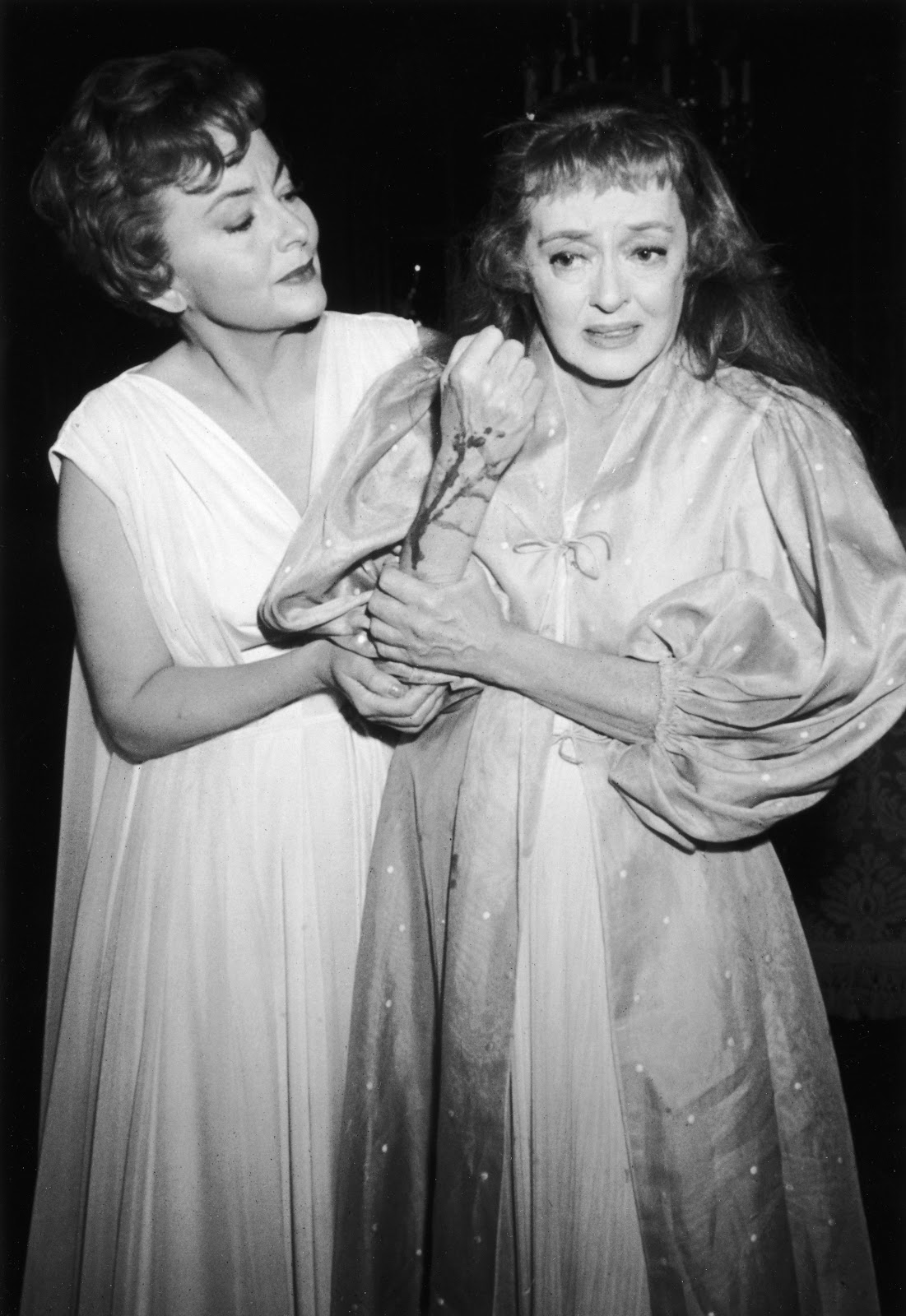
Robert Aldrich’s 1962 horror thriller Whatever Happened to Baby Jane? single-handedly spawned the psycho-biddy subgenre by successfully blurring the thin line already dividing the gossip column-generating heat of off-screen rivalries indulged at the time -- largely for publicity purposes -- by its two ageing Hollywood stars, Bette Davis and Joan Crawford, and the murderous, co-dependent animus that drives the unstable characters they play to extremes within the context of the film itself. The imaginations of movie audiences were galvanised by the histrionic performances delivered by these rival ‘Grand Dames’ of the silver screen amid the feverish atmosphere of stifled Gothic melodrama Aldrich was able to generate from Lukas Heller’s adaptation of Henry Farrell’s source novel. It was inevitable a second pairing of the veteran star actresses and the independent director would become a much sought-after commodity in the wake of the unexpected box office success and the five Academy Award nominations picked up as the fruits of their first collaboration, and so when Hush … Hush, Sweet Charlotte (1964) came along, 20th Century Fox must have been banking on the chance to considerably up the ante on its Warner Brothers-distributed predecessor, as Heller and Farrell sought to recombine their talents in the cause of helping Aldrich bring to the screen an unpublished sort-of semi-sequel short story (originally titled, with obvious self-awareness, Whatever Happened to Cousin Charlotte?) that Farrell had written to be made as another one of Robert Aldrich's independent productions, but on a considerably larger budget than had been available for Baby Jane.  


For reasons now more widely understood (and which furnish a great deal of the ample background material one will find related in fascinating detail by Kat Ellinger and Glen Erickson across the two commentary tracks included with this new Masters of Cinema release), the proposed ‘rematch’ between Davis and Crawford never materialised, Crawford’s supposed health issues apparently necessitating her removal from the production. Fascinating production stills, taken during the shooting of now-missing footage shot before Crawford left the picture, and which show the actress made-up and appearing in character as Miriam Deering, do still exist and display her very different take on a role that was eventually filled by Davis’s colleague Olivia de Havilland. Instead, free of the constant circus of speculation that surrounded the relationship between these infamous Hollywood rivals, Hush … Hush, Sweet Charlotte emerges as nothing so much as a lavish-looking Southern Gothic spin on the mini-Hitchcock thrillers that Hammer Films had been knocking out on a regular basis for some time by this point, a cycle which had started with Jimmy Sangster’s screenplay for Seth Holt’s Taste of Fear in 1961. Convoluted Gaslight mimicking narratives and endless permutations on the plot to Henri Georges Clouzot’s Les Diaboliques are what drive most of these films, and Hush … Hush, Sweet Charlotte turns out to be no exception, despite being much more handsomely mounted and exquisitely photographed than anything Hammer -- for all the studio’s brilliance -- could ever have hoped to replicate, even in its heyday.


With its generously sprawling 133-minute full feature length, Hush … Hush, Sweet Charlotte has more than enough time on its hands to cover quite a few other bases as well: among them out-and-out exploitation and shock imagery. The film racked up an impressive seven Academy Award nominations. But it’s a safe bet to assume that no other Oscar-nominated film in 1964 (and not many others thereafter) featured explicit shots of limbs being bloodily lopped off with a hatchet, or a decapitated head tumbling down a spiral staircase in an antebellum-era-built Louisiana mansion: just two of the film’s main selling points amid a whole suite of gloriously torrid horror theatrics initially disguised by the film’s prestigious cast of Hollywood greats and beautifully lush Southern locations. The film is intentionally constructed from a vast mosaic of cinematic signifiers which are deployed in this case to enable it to straddle the murky grey area that separates B movie hokum from the Hollywood prestige project without ever having to come to a decision about which of these modes should ultimately get to define it. The screenplay is seemingly precision-tooled to evoke every Southern Gothic motif under the sun and, more pertinently, details of narrative, production design, art direction and even the actual casting, conjure at every turn formless ghosts that hint at many instances of Hollywood’s representation of the Deep South on film: having Bette Davis play a fading Southern Belle traumatised by an incident from the past that robbed her of her one chance at happiness might be assumed a  reference to the kinds of roles the actress played in her younger days, when she was quite often cast as characters from a similar milieu, such as in the 1938 film Jezebel, for instance; while casting Crawford’s replacement with Gone with the Wind star Olivia de Havilland simply reminds the viewer that Davis also lost out on the role of Scarlett O’Hara to de Havilland’s co-star Vivian Lee.


The film begins with a 1927-set prologue that initially plays like a stage-bound scene from some sultry Tennessee Williams play or other: two characters on a single set confronting each other over the heavy oak desk in the study of formidable Louisiana plantation owner 'Big' Sam Hollis (Victor Buono) on a hot summer night in New Orleans, strains of jazz discernible in the distance from a party that’s in full swing elsewhere in and around the colonnaded mansion and its oak-studded grounds. Baby Jane star Buono’s interlocutor is the young Bruce Dern -- here in an early role following a brief appearance in Hitchcock’s Marnie the year before – who is tasked by the screenplay with the plot-instigating duty of getting himself blackmailed and then becoming an instant murder victim, whose death thereafter haunts the central character for the rest of the film. His name is John Mayhew: the married lover of Hollis’s young daughter Charlotte (Bette Davis). The couple had been planning to elope together on this very night, but their plans have just been exposed and thwarted after Mayhew’s wife Jewel (Mary Astor) somehow got wind of it and told Charlotte’s father. Under pressure from the overbearing patriarch, Mayhew later that night breaks off the elopement with Charlotte in the summer house, leaving her heartbroken. Not long after he is dispatched in the grisly fashion already alluded to. The young Charlotte Hollis, the lower portion of her party dress stained red with her lover’s blood, then wanders semi-comatose into the crowded ballroom of the Hollis mansion, confronting her father and all his guests with this menstrual symbol of the family shame.


Did she kill Mayhew or was the deed done by her overbearing father? Thirty-five years later and the locals of Hollisport continue to debate the macabre legend which has grown up around the lurid events that took place in the home of the reclusive Charlotte Hollis all those years ago. The ageing occupant now lives on the site of the former plantation like the Miss Havisham of Baton Rouge: quite alone apart from her dishevelled housekeeper Velma (Agnes Moorehead) who devotedly tends to her needs and sees off any troublesome trespassers. Pining for her dead love, Charlotte Hollis is believed by most to be mad; children might dare each other to sneak into the old mansion at night, but those who attempt such a feat are liable to find not an axe murderer but only a disorientated old lady in white, still clutching at a box that just might contain the head of her dead lover … or perhaps, maybe, it's the music box Mayhew gifted her thirty years ago, that plays the song he wrote for them both. There is the common suspicion within the community, though, that Charlotte herself was Mayhew’s murderer, and that she has been protected from punishment all these years by her late father’s influence and power, which still seems to exert itself from beyond the grave even now.


The fabulous location exteriors used for Hush … Hush, Sweet Charlotte play an instrumental role in imbuing the film with the requisite sense of faded historical grandeur, crucial in conveying the latent idea that sins of the past once obscured by these stately residues of a supposedly more genteel age are only now being exposed to light again, as the past crumbles or is forgotten. The plantation owners of the 18th and 19th centuries built their grand homes with those imposing upper balconies and columned porticos, in a neo-classical Greek Revival style intending to associate themselves with the great splendours of a former European civilisation. But the history the architecture of the Antebellum now represents to most of us is, of course, also marked by a darker side: the fact that its beauty was founded on the prevalence of slavery as a tool for economic dominance and social oppression. Charlotte Hollis lives in an anachronistic museum commemorating the historic brutality of this ‘golden’ age once presided over by her late father and his immediate ancestors, and given actual form in the historically preserved location of the 1840s plantation house Houmas House in Burnside, Louisiana that was used for the exteriors -- one of the grandest of its design. In the present day, Charlotte has herself practically become a ghost from this vanished age. Never having come to terms with the belief that her father was responsible for John Mayhew’s murder, she remains frozen in the shock and grief of that immediate moment from all these years ago, only being spurred into action when her family home is threatened with demolition to make way for a new highway. Even more ambiguous a commentary on the shadow of the past is a scene that comes halfway through the film, in which the kindly insurance investigator who takes pity on Charlotte, Harry Wills (Cecil Kellaway), takes tea in the grounds of the house owned by Charlotte’s great rival, the ageing Jewel Mayhew (Mary Astor), and talks with her about that fateful night many years ago when Jewel’s philandering husband was decapitated in the summer house at the Hollis mansion. Aldrich uses as the backdrop to their talk the picturesque sight of a canopied oak allée from the Oak Alley Plantation in Vacherie, Louisiana: a location so exquisitely designed to fit a romantic view of the past one would almost have assumed it to be a matte-painted background created specifically for the purpose of conveying that impression. The film is all about the prevalence of masks, and the most deceptive mask is the mask of nostalgia: it cloaks all manner of ills in the soothing afterglow of best intentions and whitewashed motives.      


While the historical authenticity of the exterior locations allows the film to become infused with an atmosphere of stately decay and moral ambiguity, the studio-created interiors and the way they are staged, dressed and shot by Aldrich and his repertory company of regular crew members, attest to the continued potency of Gothic horror and its macabre genre offshoots. Art director William Glasgow and cinematographer Joseph Biroc are primarily responsible for creating the rich velvety high-end noir atmosphere enveloping the ornate décor of Hollis House, while costume designer Norma Koch puts the older Bette Davis in platted pigtails and flowing nightgowns to emphasise how the character of Charlotte is trapped in her youthful past even as she plays out the role of a traditional Gothic heroine. Davis gives another committed full-throttle performance that holds nothing back: she may not get to be as demonstrably evil-hearted as she was in Baby Jane but a good portion of the film requires her to inhabit various stages of insanity as visitations and hallucinations of severed heads bouncing down the staircase and-the-like begin tormenting her one by one, as does some ghostly harpsichord music that plays in the night and an encounter with faceless guests in a dreamlike slow-mo ballroom sequence recalling her last night with Mayhew. Frank De Vol’s music once again strikes a fine balance between saccharine irony and sweeping melodrama, particularly on the title song (a rival to Baby Jane’s I’ve Written A Letter to Daddy) which serves multiple roles in the film: one minute functioning as the creepy music box motif associated with Charlotte, and the next as an eerie harpsichord air to signify her final descent into madness. It later also transformed itself chameleon-like into a pop hit of the day for Patti "(How Much Is That) Doggie in the Window" Page!


Davis’s florid performance is complemented by an equally robust comic turn from Agnes Moorehead, as muttering maid Velma. A fine character actress who at the time would have been best-known for playing Samantha’s mother Endora on the TV series Bewitched, Moorehead's career stretched back to the 1930s when she did a stint with Orson Welles’ Mercury Theatre troupe, performing alongside Joseph Cotten, who now joins her again in this film for a smallish role as Charlotte’s doctor, Drew Bayliss. As the former lover of Miriam Deering, Cotten delivers the required levels of sliminess in a role originally slated to have him play most of his scenes opposite Crawford but which eventually saw him working with Olivia de Havilland instead. The couple’s relationship dates back to the time of John Mayhew’s murder in 1927. Bayliss broke it off back then with Miriam because of the scandal associated with the Hollis name in the wake of Mayhew’s death -- meaning Miriam is returning to a site that holds painful memories not just for cousin Charlotte but for her too. Those memories are made all the more tangible when Miriam comes back to Hollisport at the request of her cousin after years living a metropolitan life in the big city. Charlotte wants her to help in the fight to oppose the building of the highway on the site of the Hollis mansion, but Miriam returns to find that, forty years later, her old lover Bayliss is still the acting family physician. While everyone else appears to be trapped in an emotional time warp by the events of forty years ago, Miriam comes across as a stable, level-headed person who is being forced into confronting the tumult of her past against her will. But of course, this being a Gothic-themed thriller, with all the twists and turns that entails, the truth of the matter proves to be a great deal more complicated. Olivia de Havilland is probably a much better casting choice in that regard than Joan Crawford would have been, since she initially exudes an air of normalcy that makes her a viewer identification figure from early on in the movie: a witness to the madness, eccentricities and abnormalities of all the other characters, and a good steady foil to the exaggerated flightiness of Davis’s character. As the plot unfolds, a harder edge emerges to her Miriam Deering and one of the film’s major strengths lies in the way de Havilland manages her character’s transition from apparently innocent bystander to the prime instigator of some pretty fiendish events. The plot itself might not contain anything truly surprising, and is pretty much boilerplate thriller material but de Havilland gives a fully rounded performance that holds the attention throughout, while Aldrich manages to sell a whole plethora of deranged, surrealistic sequences in the second half that makes the ride entertaining even if we’re never truly in any doubt as to the eventual destination.


Hush … Hush, Sweet Charlotte was always a handsome-looking film, and it finally gets a fitting 1080p HD presentation for this UK Blu-ray release from Eureka Entertainment as part of The Masters of Cinema series. A 22-minute archive ‘making of’ featurette contains all the basic background production facts on the film, and Bruce Dern provides a nice 13-minute interview in which he recalls his interactions with Bette Davis on set and behind the scenes. There’s also a brief 5-minute contemporary set report narrated by Joseph Cotten. But the two stand-out commentaries are the main centrepieces of the extras package included here: Kat Ellinger once again proves her worth with a well-researched track that takes a thoughtful look at, among other things, Robert Aldrich’s relationship with the ‘women’s picture’ and the cross-over he forged with noir and Southern Gothic. Meanwhile, Glenn Erickson provides a more traditional overview, concentrating on biographical info about the main cast and crew members. Both contributors tackle the Joan and Bette feud and the drama of Crawford’s replacement by de Havilland, each managing to bring an individual take to the business without contradicting the other on the basic facts. Trailers and TV spots are included, and this Blu-ray only release also comes with the traditional collector’s booklet, this one featuring a new essay by Lee Gambin illustrated with some fascinating archival imagery.


Hush … Hush, Sweet Charlotte is a gorgeously overwrought piece of Gothic melodrama and a fine example of the mid-sixties ‘twist in the tail’ thriller. It has some great performances from usually side-lined older actresses, while the likes of Joseph Cotten, George Kennedy and Cecil Kellaway are this time relegated to supporting roles. Aldrich gave what could have been considered relatively trivial by-the-numbers material his full directorial attention, creating a lush spectacle of Gothic madness that delves into all manner of twisted psychological unpleasantness with a wilful glee. The cast of Hollywood greats at its centre seems to have been more than happy to follow Aldrich wherever he may lead them, in what has turned out to be a much-overlooked gem of the genre.    

Sunday, 13 January 2019

Blu-ray Review: LAURA (1944)

The 1944 Hollywood movie Laura plays for the most part as if it were a conscious postmodern deconstruction of film noir character types and motifs despite the fact that the term "film noir" did not become available for use until years after this acknowledged classic of the subgenre had been released. This is surely the biggest consequence of the fact that the  source novel and the subsequent play on which the film was originally based were the work of a female writer, Vera Caspary, who was obviously aware of the 1930s tradition of hardboiled fiction by male writers such as Dashiell Hammett and Raymond Chandler -- the key literary influences and sources of what came to be known as film noir  -- yet was herself drawing more upon a template established by the popular "Sensation Literature" of the middle of the 19th century in work by writers such as Wilkie Collins, Mary Elizabeth Braddon and Ellen Wood. With Laura, Caspery, much like her near-contemporary Daphne Du Maurier whose Rebecca is a clear reference point, was attempting to unpick, in a particularly acute way, many of the gender roles that underpin this area of fiction, using a reformulation of the devices previously employed by writers of great Victorian popular literature.

Sensation Literature narratives often revolved around strong independent-minded female characters who pose a challenge to the gendered patriarchal domestic institutions that greased the gears of Victorian society. These narratives frequently relied on unexpected, rug-pulling twists devised to force the reader to reassess former prejudices as apparently ‘respectable’ characters are revealed to harbour dark destructive secrets that fester at the heart of English suburban society. The genre also produced, in Collins’ The Moonstone, a novel widely considered to be the first detective story in English literature.


The 1943 novel of Laura, as initially conceived by Caspary, relies on multiple narrators each providing their own unique and individual perspective on events, and thus raising the spectre of the unreliable narrator: a mainstay of the Sensation genre. The film, though, in structurally simplifying much of this, actually creates yet more ambiguity. The title character becomes, in the first half of the film, an unobtainable male fetish object accessed only through the many distorted reflections produced by second-hand accounts of her brilliance that emphasise only their vainglorious narrator’s projection of an idealised form of femininity: a quality the film itself echoes with a mise-en-scène shot through a gauzy, romantic high-gloss sheen. 

It’s noticeable that 20th Century Fox, recently back under the control of Darryl Zanuck after his period of leave for army service, envisioned Laura as an A-List project almost from the start: there is no skimping on glamour and prestige in any area of the production, as is highlighted by the film’s five Academy Award nominations. Production design, cinematography and costuming are all rendered with exquisite elegance, in presentation of the milieu of the sophisticated Manhattan smart set providing the film’s decorative backdrop and shrouding the entire production in an entrancing, dreamy aura that’s quite at odds with the more usual gritty style associated with the crime, mystery and investigative genres. Laura is an ingenious murder mystery presented to audiences in the form of a refined woman’s picture of the same period: its sophisticated cast performances highlight at every turn the involved nature of the twisted character relationships that propel the narrative, as opposed to the approach taken by a contemporary film such as Mildred Pierce (1945) for instance, which was a relationship drama and character study in its original form that had these elements simplified for the screen so that murder and noir trappings could be added to the adaptation for commercial reasons.

Laura, which can also be thought to be a crisply mounted noir precursor to Alfred Hitchcock’s Vertigo, is a film about the male gaze that exemplifies, in style and character, every domineering surface aspect of the attempt to obliterate the self-determination of its female subject. In the film, we are presented with three male leads, each of whom is shown (through being either a suspect in a woman’s murder or a detective with a hand in the investigation) to have a connection to the murdered Laura Hunt (Gene Tierney). But only by the images of her they present to us and each-other do we as viewers have any access to her at all. Then, halfway through the picture – and this is the big twist or spoiler that underpins the film’s reputation, so stop reading now if you wish to remain blissfully ignorant -- we discover that Laura Hunt is not actually dead at all. She suddenly walks into the film as a living, breathing presence, at which point she goes instantly from being a potential murder victim to the chief suspect in a murder plot.


In a way, the film’s production history rehearses themes central to the narrative to an uncanny and mordantly ironic degree: Caspary, a female artist, who writes a story about a young ambitious woman whose life, work, image and very memory are fought over for interpretation by a group of men, was to find the same thing happening to the story itself when producer Otto Preminger, studio mogul Darryl Zanuck and their proposed directorial choice Rouben Mamoulian got to work on remoulding it into something that might function as a cinematic rather than a literary vehicle. Caspary clashed with Preminger early on over the decision to drop the concept of multiple narrators which underpins the novel in favour of the third-person objective ‘invisible’ narrator preferred in most Hollywood cinema. But the labyrinthine rivalries and insecurities that the project exposed between the three male creatives when they took over the reins of Caspary’s vision couldn’t be more symbolic of the clash of male egos and romantic delusions that the film they eventually crafted from the source novel depicts so piquantly.  


When Otto Preminger first identified Laura as a potential project that could be brought to the screen, he’d been working practically covertly at Twentieth Century Fox under its "caretaker" head William Goetz. Preminger had earlier been frozen out of Hollywood altogether after falling out with Fox co-founder Darryl F Zanuck in 1937, over his direction of Zanuck’s screenplay of Robert Louis Stevenson’s Kidnapped. Unable to find work elsewhere, he’d returned to his theatre acting roots and had great success in long-running productions acting alongside, among others, Vincent Price. While Zanuck was away doing his army service, Goetz had brought Preminger back in from the cold, employing him as both actor and director on a number of B pictures at Fox. When Zanuck returned, though, and immediately started discarding all of Goetz’s films, Preminger feared for a time that his brief spell of favour had come to an impromptu end. Instead, Zanuck summoned him to a meeting where Preminger learned that he would be allowed to stay on as director of the minor war picture he was at work on at the time, but that he would only be allowed to produce Laura.

Even then, the property almost got shelved when the head of the B unit, Bernie Foy, decided on the advice of his reader that he did not like the script. It took Zanuck himself to come to the rescue when he upgraded the production to the ‘A’ unit and decided that he would also supervise it, working alongside Preminger as the production's script doctor. It was also Zanuck who voiced the need to make the characters 'real outstanding personalities', determining that in order to be successful the film had to aim to be more than just another 'blown-up whodunit'. One of Caspary’s original bugbears with Preminger was that he only wanted to make a conventional detective story, although Preminger had also sensed, correctly, that Laura Hunt’s fastidiously epicene mentor Waldo Lydecker should be made the central spoke in the narrative hub. Zanuck, meanwhile, realised that Laura should come into the story as 'a breath of spring' to contrast with the 'Park Avenue cutthroats' who otherwise populate it.


As the producer of the property, it was up to Preminger to find someone suitable to helm Laura. Successful stage and screen director Rouben Mamoulian seemed like a brilliant choice at first: he was one of cinema’s earliest and most innovative pioneers of the movie musical and of mobile camera technique (who oversaw the making of the first three-strip Technicolor movie made in Hollywood), and was seemingly a perfect fit for a film with the prestige status Zanuck’s stewardship seemed set to bestow upon the production. However, problems soon began to mount behind the scenes, principally over Preminger’s dissatisfaction with Mamoulian and Zanuck’s casting choice for the crucial role of Waldo Lydecker. They’d plumped for an actor, Laird Cregar, who had just become well known for playing Jack the Ripper in the 1943 version of The Lodger. To cast Cregar as Laura’s tart bisexual mentor would be to throw too much suspicion on his shoulders, identifying him as the prime suspect in the mystery from the off. Preminger much preferred a little-known actor called Clifton Webb, who had thus far confined himself mainly to the stage, appearing in musical comedies and revues. Webb’s off-screen persona – cuttingly loquacious, upper-class and openly homosexual – signalled those important elements of Waldo Lydecker’s fastidious nature that still could not be openly stated on screen in 1944, plus the actor was virtually unknown so anyone watching would have no cause to suspect him over any of the other shifty high-class Manhattanites portrayed in the film. 

Preminger managed to get Cregar replaced with Webb behind Mamoulian’s back, despite initial opposition from Zanuck. When the dallies started coming back from Mamoulian’s closed set, both Zanuck and Preminger expressed dissatisfaction with the overly theatrical way he was directing some of the actors, particularly Judith Anderson. In meetings between the three men, Preminger was only too happy to spell out where he thought Mamoulian was going wrong, and it wasn’t too long before Mamoulian was off the film and Preminger found himself finally in charge of the production, scrapping everything that had been done so far and starting again from scratch with a new cameraman, Joseph La Schelle, and a new scenic designer, Lyle Wheeler, who was soon to garner a reputation as the designer of some of Hollywood’s most lavish productions.  

Preminger directs Laura with understated grace and restraint studded with the occasional unconventional flourish -- like the sudden whip-pan in the opening scene that introduces society newspaper columnist Waldo Lydecker, naked in his marble bath but still tapping away on the typewriter suspended above it. The world of New York high society was one Preminger had moved in himself and understood implicitly to be elegant and attractive on the surface but populated by ruthless vipers. The casting choices were essential for teasing out the dysfunctional interplay of psychological pathologies at work in the subtext of the scrip, with the effete Clifton Webb playing against leading man Dana Andrews’ rugged investigating detective, Mark McPherson. The opening scene demonstrates how harmoniously the casting, décor, photography and script combine to create the film’s textured air of feverish mysteriousness, with McPherson rendered ill at ease amongst the fussily arranged glass display cabinets and quaint antiques of Lydecker’s high-end suite, the columnist’s penchant for extreme feminine fetishisation already becoming apparent to us from his immaculately curated surroundings. Lydecker even mythologises and attempts to control McPherson’s masculinity, quoting from an article he’d once written about the detective after he sustained an injury during a siege that resulted in the death of a gangster: “The detective with the silver shinbone” sounds like the title of a hardboiled crime fiction that might have been written by Raymond Chandler, the film cleverly fixing immediately how we view McPherson through the words and sensibility of its most manipulative character. There’s even a fairly overt-for-the-time frisson of homosexual flirtation in the air when Lydecker casually rises from the bath in the nude and asks McPherson to hand him a washcloth, the manly detective casting the fey newspaper columnist a wry split-second sideways glance before doing so.


The detective is ostensibly there to interview the self-regarding Lydecker about his relationship to the supposedly murdered woman, Laura Hunt, who has (apparently) been found in her apartment, shot in the face at point-blank range after answering the door buzzer dressed in her night robe. He claims to be ‘the only one who really knew her’ and imperiously insists that she considered him to be ‘the wisest, the wittiest, the most interesting man she’d ever met.’ McPherson also speaks to Laura’s serpentine playboy fiancé Shelby Carpenter (Vincent Price), a parasitic hanger-on who seems equally as effeminate and ineffectual as Lydecker paints him to be, and who appears to be happy to accept the continuing financial assistance of Laura’s wealthy socialite aunt, Ann Treadwell (Judith Anderson) -- who is, in turn, totally infatuated with him but unapologetically hard-nosed about that fact, and about both their many personal failings.

The catty rivalry that's on display between the two men, and which McPherson deliberately facilitates as a tactic to try and determine the facts about what really happened between them and Laura, is at the centre of a lot of the film’s most acerbic and quotable dialogue as well as its mystery. But when McPherson goes with Lydecker to visit what used to be his and Laura's favourite restaurant, the film goes into an extensive flashback sequence in which we see how he promoted her climb up the career ladder to the top of her profession after she approached him speculatively, while an ingénue with an advertising firm, hoping to secure his endorsement on a campaign she’s been working on for a new fountain pen. (‘I don’t use a pen. I write with a goose quill dipped in venom!’ he responds, sniffily, to her initial request.) 

Lydecker starts to live an obsessively vicarious existence through Laura's ensuing professional and social successes, revelling in fashioning for her a new, sophisticated identity that might almost be an alternative feminine version of his own. He secures her more endorsements and thus helps her progress at the advertising firm; he shows her how to carry herself in high-status social circles; he decides what clothes she should wear and how she should arrange her hair. Although it is platonic, the obsessive nature of their relationship encourages a sickly proprietary attitude in Lydecker with regard to who Laura can be seen associating with. He essentially starts stalking her: he’s jealous of the infatuated artist who painted her portrait which now dominates the mantelpiece in her apartment lounge, and he’s disapproving of her relationship with Carpenter, when she hires him to work with her at the advertising firm after meeting him at one of the upper-crust soirees Ann Treadwell regularly holds to help Carpenter get a foothold in the dissolute echelons of Manhattan’s beau monde.


After listening to all of this being so eloquently expressed to him by Lydecker, and then seeing the magnificent portrait of Laura in her apartment building, McPherson essentially falls in love with the mythical image of a dead woman -- a development that brings a perverse hint of necrophilia with it to the dreamy romantic atmosphere that predominates in the film, largely thanks to David Raksin’s memorable score based around the theme he wrote for the title character. It results in a heady mixture that raises all sorts of unanswered questions about the true nature of the couple’s relationship when the real Laura unexpectedly turns up again out of the blue, and it is revealed that the murdered woman was, in fact, a model called Diane Redfern from the advertising campaign Laura and Carpenter had been working on together, and whom Carpenter had been having a liaison with at Laura’s flat while the latter was away in the country deciding whether to marry him or not! McPherson’s subsequent courtship of Laura is simultaneously being conducted, then, as a murder investigation in which she has now been made the main suspect, while Lydecker’s obsession with the version of Laura he has constructed for public consumption (and which McPherson has fallen for) is now even more challenged by the flesh and blood Laura’s choice of romantic partner, as Lydecker gradually realises that she is responding to detective McPherson’s overtures.


Lydecker’s dialogue throughout the film is peppered with waspish expressions of apparent disgust for any kind of overt demonstration of male physicality, putting further emphasis on his own inability to successfully masquerade as heterosexual in this area of his life by suggesting the true direction of his own proclivities if he (and the film) could only admit to them! One can practically sense Lydecker’s repressed frustrations boiling over in lines like: 'If McPherson weren’t muscular and handsome in a cheap sort of way, you’d see through him in a second', and 'I hope you’ll never regret what promises to be a disgustingly “earthy” relationship!'  Vera Caspary was always unhappy about Otto Preminger’s decision to change the novel’s climactic revelation, in which it is discovered that the pistol that killed Diane Redfern has been concealed in the handle of Lydecker’s walking cane all along – a deliberately placed Freudian symbol that stands for the character’s sexually impotent destructiveness. But, in a way, Preminger’s alternative -- of having the phallic murder weapon hidden instead in a secret compartment inside the body of the replica copy of Lydecker’s elegantly adorned antique clock (which he gave to Laura as a present and which now stands in her apartment) is a perfect metaphor for the film’s unspoken theme, in which closeted homosexuality is covertly depicted finding its sublimated but unstable release through a vicarious usurpation and impersonation of feminine identity. One can understand Gene Tierney’s initial reluctance to take on a role that actually requires her to pose as a remote and not fully realised character for much of her time on screen, and one in which she is almost completely defined by the men around her; but Tierney, of course, has no trouble in rising above all of her male co-stars in one of the most memorable screen portrayals of the 1940s. Nevertheless, one cannot help but agree with detective McPherson’s rather accurate assessment of Laura Hunt’s poor choice of relationships when he tells her: ‘I must say, for a charming, intelligent girl you’ve certainly surrounded yourself with a remarkable collection of dopes!'


It’s wonderful to see this exquisite noir finally receiving a UK Blu-ray release in which its beautiful photography really gets a chance to shine. It’s part of Eureka Entertainment’s Masters of Cinema collection and comes with some nice extras including an archive featurette on the film; a video interview with composer David Raksin; and two commentary tracks: one in which film professor Jeanine Basinger, Chairman of Film Studies at Weston University, Middle Town, Connecticut provides an excellent analysis of the film with occasional separately recorded interventions from Raksin regarding the score; and another in which film historian Rudy Behlmer concentrates on the production history of the film. 

The disc also includes four radio adaptations, including the Lux Theatre one hour broadcast from 1945 which starred original cast members Gene Tierney, Dana Andrews and Vincent Price. Philip Hoad contributes an essay to the accompanying collector’s booklet, which also features a selection of rare archive images.

Laura is a key entry in the psychological noir subgenre of the 1940s, where flashbacks and false memories and a dreamy sense of romantic ennui dominate the mood. Often these films fell squarely into the Gothic Romance genre. But Laura straddles the borders of Gothic ghost story, romantic thriller and detective mystery like no other: a perfect blending of genre elements that combine to produce a uniquely ravishing, beguiling effect on the viewer in a film that continues to cast its hypnotic spell across the decades. Let this release contribute to that spell lasting for many more years.


Sunday, 3 June 2018

CURE (1997)

When the boom in Japanese horror took off in the West during the early 2000s it apparently arrived fully formed, attracting attention largely on the back of the landmark statement made at the time by Hideo Nakato’s Ringu, its various sequels and offshoots, and the franchise created with Takashi Shimizu’s extensive roster of Ju-On (Grudge) movies. But, from very early on in the critical discussion surrounding the distinctiveness of the J horror scene, it became de rigueur to refer back to Kiyoshi Kurosawa’s unnerving 1997 psycho-thriller Cure as the ground zero of the phenomenon; a template that set the style and tone for what was to follow despite very marked differences to most other entries in the sub-genre. Oddly, though, given its importance to the development of this branch of horror, the film always remained quite hard to see. Devotees of Asian genre cinema had to actively seek out region three or region one DVD releases in order to view it. And UK fans had a particularly hard time of it when it came to the availability of Kiyoshi Kurosawa’s work in general. Only in the last year or so -- with his award-winning films such as Tokyo Sonata having by now acquired the director some measure of arthouse respectability -- have Kurosawa’s career-making horror masterworks from the nineties and early 2000s started to filter into the UK market; and this new dual-format Blu-ray/DVD release of Cure (definitely the director’s career breakthrough) from Eureka Entertainment’s Masters of Cinema imprint, marks the film’s debut in this country … a bewildering state of affairs for a film that stands up now as well as it ever did, and which can also be said to have transcended its original role as midwife to the J horror explosion and become just as essential to any consideration of the emergence of the modern form of what, these days, might be referred to (for better or worse) as arthouse horror. In a new interview included with the Eureka release, Kurosawa himself muses on why the film has endured and concludes that it is “a unique combination of art film and genre film”, before going on to compare it in style to the work of David Cronenberg.   


Cure does not deal in overtly supernatural phenomena like most of its J horror cousins: there are no wronged, long-haired female ghostly spirits here, spreading unstoppable curses passed along through the conduit of technological communications. If anything, it’s far more profoundly disturbing on a philosophical level for being much harder to pin down just what exactly is supposed to be going on during large chunks of this picture’s narrative, precisely because we are not afforded the luxury of being able to label any of it supernatural. Although suggestive allusions to ‘occult ceremony’ are made near the end of the film, they are all the more unnerving for remaining speculative and poetic in their nature. The narrative seemingly operates on a mythic/symbolic/metaphoric plain, despite being grounded in a series of identifiable, familiar urban locations. And Kurosawa achieves his effects by refusing to be pinned down to logical explanations, evoking instead a sense of loneliness and emptiness by his choice of settings: anonymous, semi-industrial sites on the edges of cities. Abandoned or decaying, they have often been cleansed of significant historical markers in a process of constant renewal and permanent redevelopment suggestive to viewers of a modern malaise of the psyche, as pictured in landscapes nurtured in the aftermath of the bubble economy of 1990s Japan.

The film has a quirky, tangential style, full of narrative ellipsis and ambiguous, hard-to-read occurrences much in evidence from the opening scenes and continuing throughout. Even so, it also seems at first to be a pure exercise in neo-noir rather than straight horror, essaying a mix of story elements that refer to then-recent developments in the genre such as Jonathan Demme’s The Silence of the Lambs and David Fincher’s Se7en, rather than to contemporary Japanese ghost stories. Thus, the film appears initially to be defined by the conventions of the detective genre: a few minutes in, and we are presented with the familiar figure of the rain-coated detective, here played by Kurosawa regular Kôji Yakusho. Detective Takabe is introduced to us in a scenario straight out of a standard police procedural: he has been called to the scene of a crime in which the mutilated body of a prostitute has been found by a cleaner in a blood-splattered Tokyo hotel room … So far, then, so familiar. Forensics is being gathered by a team at the site, and clues are being amassed in the usual manner as it is established that the woman has been knocked senseless with a blow to the head from a piece of lead water pipe, then left to bleed to death from an injury to her neck caused by a large letter ‘X’ carved into her throat with a knife. It doesn’t matter if a handful of disconnected scenes or images don’t quite add up, because we expect the fragmented pieces to get slotted into place as the film progresses, and as the detective starts to match motive with suspect to reach the end of a process of ratiocination that will result in all becoming clear to us, as well as to him, at the end of the picture. Or, as Takabe puts it himself at one point “All I want is to find words that will explain the crime … that’s my job.”


Solving crime for Takabe, then, is as much about uncovering, understanding and assigning motive as it is about the identification of a perpetrator. Yet Takabe’s psychologist friend Sakuma (Tsuyoshi Ujiki) sees things rather differently; he assumes that people invariably go about their lives without awareness of what truly drives their actions, then concoct a narrative afterwards to explain their behaviour to themselves as much as to anyone else: “No-one can understand what motivates a criminal,” 
he asserts; “ sometimes, not even the criminal.” This notion militates against the very idea that criminal acts can be slotted inside a full logical system to explain human behaviour: “People like to think a crime has some meaning,” Sakuma later states … “but most of them don’t.” Instead, Sakuma assumes that we must stick to matching specific crimes to identified perpetrators, and be content with that.

This first act tension between two opposing philosophical outlooks represented by the investigative leads might be assumed to drive the thematic underpinnings of the film’s events for the rest of the narrative -- but Kiyoshi Kurosawa makes it the point of the picture instead to undermine from the start both identity- and motive-based methods for arriving at any firm conclusions. Takabe and Sakuma are dealing with a case that defies all approaches to understanding; indeed, one that doesn’t play ball at all with the very assumptions that define criminal investigation. It’s this undermining of the intrinsic ground rules of the genre that he is nominally supposed to be working within that enables – indeed forces -- Kurosawa to send his characters off instead on an experimental journey that becomes an abstract investigation into the psychological foundations of (Japanese) identity itself.


We find out early on that what has been so perplexing Takabe and Sakuma about this case comes down to the fact that the prostitute’s murder is the third killing they have investigated in the last two months to exhibit the same modus operandi, which suggests the work of a single serial killer. Yet, each time, there has turned out to have been a different perpetrator responsible, each one unconnected to and unaware of all the others and despite a news blackout being put in place on the details of the crime wave ruling out the possibility of copycat killings. The prostitute’s killer is also picked up, still at the scene, hiding naked in a service hatch in the corridor just outside the very hotel room in which the murder was committed. Like all the others, he vaguely remembers carrying out the crime but can offer no explanation for his actions. Takabe is faced, then, with the conundrum of being expected to bring to an end a continuing and escalating wave of identical murders, but with no single suspect to focus on apprehending and no motive whatsoever to explain any of what has been happening!


Eventually, Takabe comes up with a solution that appears to provide him with a way out of this head-spinning impasse, and also a means of providing closure to the case while still maintaining a rational investigative framework. A suspect is apprehended who seems to have a connection to several of the bewildered perpetrators. (Throughout the film, the viewer has also been following this man’s interactions with these various persons who later go on to kill in an unpremeditated fashion.) Takabe latches onto the idea that this man, known as Mamiya (Masato Hagiwara), has somehow hypnotised all of these previously upstanding, conscientious, law-abiding citizens and one-by-one turned them into an army of killers. All that now remains to find out is how and why.


This idea recalls the central concept behind Fritz Lang’s sequel to his 1922 film of Dr. Mabuse, der Spieler (Dr Mabuse, the Gambler) where, at the end of the original story, inspired by Norbert Jacques’ novel, the German criminal mastermind Dr Mabuse -- who has exerted such dominance over an entire nation by personally presiding over a vast network of fraud and conspiracy -- goes insane and is confined to an asylum indefinitely. In the sequel, made ten years later, Das Testament des Dr Mabuse (The Testament of Dr Mabuse), Mabuse is still quite mad and has by now become totally incoherent. He continues to be confined to his cell and has no access to the outside world. Yet, his criminal network seems to be back up and running, and Mabuse’s identifiable personality seems to be all over a series of crimes that are once again sweeping the German capital. Halfway through the film, Mabuse actually dies, yet his crimes continue unabated -- as though his will has somehow transcended his physical form. It transpires that during the course of his obsessive study of his patient, the director of the asylum has taken on Mabuse’s characteristics through a process of transference akin to possession, and now continues to carry out the Mabusian program of destruction in his former patient’s place. Lang was tapping into the mood of his time as German democracy collapsed into fascist tyranny, and predicting how the will of a strongman leader could corrupt an entire nation by shaping and distorting the zeitgeist. In the end, it doesn’t matter if that leader is even around anymore: the environment and the culture he shaped continue to impose his will without him. The main difference with Kiyoshi Kurosawa’s formulation is that at the centre of all the criminal activity in Cure, there appears to be the very opposite of a Mabuse-style dominating personality to impose his personal will on others through overpowering charismatic force and mesmeric influence. Instead, Mamiya appears to have no personality at all; no identity or recall of his own past, and barely any short-term memory.


While Mabuse captures the notion of powerful ideas turning into social contagions that can take on a life of their own, Kurosawa’s more ambiguous, abstract take on the concept strips out all sense of their having an origin in a personality or personal doctrine, and jettisons any ego based foundation that might ground such a contagion in a firm sense of continuing identity. It seems a specifically Japanese take on the subject: the approach of an anonymous, modern but conformist consumerist society that ranks cohesion of community above the needs of the individual. The film was made against the backdrop of the Aum Shinrikyo Sarin subway attack, not long after Japanese society had experienced a profound moment of existential crisis that led it to ask itself how so many educated graduates and apparently stable citizens could have been drawn to a doomsday cult espousing the mass slaughter of its own people. In the mid-1990s, the Japanese Government’s Cultural Affairs Agency registered 183,470 groups as religious corporations (reported in Damian Thompson’s The End of Time: faith and fear in the shadow of the Millennium, published in 1996). Yet these were essentially home-made religions – or what in the West we would dismiss as ‘cults’ -- which were springing up with such frequency precisely because Japan had become the type of society where, as Thompson reports, ‘there was no stigma attached to joining them.’ Indeed, sociologists of Japanese society have apparently identified four waves in the expansion of interest in such doomsday groups and small-scale religions, each one associated with a period of social upheaval caused by rapid industrialisation, natural disaster or war.


So, in Cure, we have what appears to be a detective story. But it is a detective story in which we are presented with a crime wave that has no explanation reducible to individual psychology, merely an endless series of perpetrators with no motive, and the correlation each of them has with an amnesiac who has no sense of self and no understanding of the social setting in which he exists. Takabe repeatedly attempts to progress his investigation by conventional deductive means, but each time he appears to be making progress in uncovering a piece of information that might be used to build a psychological profile of the blank space that is Mamiya, all he actually ends up doing is highlighting the ambivalences that underlie his own sense of identity, emphasising the double life he leads as a carer for his young wife (Anna Nakagawa) while being forced to watch powerlessly and to accept the consequences, as her identity slips away due to some sort of early-onset dementia. His stoic existence outside of work is contrasted with his persona as a cop who, as a requirement of his job, is under constant pressure to establish identity, forge motive … in short to produce meaning. “The detective or the husband; which is the real you?” Mamiya taunts, at one point, as detective and suspect play out a tenuous variation of the prison cell confrontation scene so familiar from countless examples of the genre Kurosawa is experimenting with here: “neither one is the real you … There is no real you.” The two incompatible sides of Takabe’s character are constantly being brought into conflict by the very interrogation process on which Takabe must rely when assessing Mamiya’s involvement with the case, causing an internal existential crisis of Being that can only be soothed with the ‘cure’ Mamiya’s solution offers to all those he encounters.


Takabe’s interactions with Mamiya put him in the same perilous situation as the perpetrators we have seen committing terrible crimes after they also have encountered this anonymous person, in a variety of earlier contexts. The feeling of unease and the mounting sense of dread Kurosawa establishes throughout the film, as Takabe is being inexorably drawn towards an indefinably disturbing new understanding of himself and the world around him, is achieved with a technique dependent on Kurosawa’s masterful formal control of compositional elements, and a suite of visual components all working together to bring about a profound effect on the viewer that seems far more than the sum of its parts, and is almost impossible to put into words. Key to Kurosawa’s method is how he completely marinates all aspect of his visualisation of the narrative in a soup of Jungian archetypes, to such an extent that the movie doesn’t just reference them in passing but is dependent on a fictional landscape completely constructed out of them. During the film, a breakthrough in the case with implications for the development of Takabe’s attitude towards both his job and his wife’s condition, comes when he discovers Mamiya’s decaying apartment on the grounds of a run-down construction site: it’s stuffed with text books on the treatment of personality disorders and works by Carl Gustov Jung, and appears to bear out Takabe’s theory concerning how Mamiya may have influenced the spate of crimes by confirming that he was indeed once a psychology student who at one time studied the animal magnetism of Franz Anton Mesmer. The astute viewer might feel at this point that they have also been made the subject of an attempt by a master of suggestion to bring about a trance-like hypnotic state of mesmerism, this time carried out by the director. The film is suffused with Jungian symbols, particularly those of fire and water, all suggestive of the idea that the surface personalities of the perpetrators of the various murders Takabe has been tracking are indicative of the eternal narratives of the unconscious, built from an intertextual web of character types, images, story structures and genre types that constitute the stuff of all storytelling. As, of course, Kurosawa’s own narrative itself demonstrates in its own construction.


Mamiya’s first appearance in the film occurs on a desolate beach, where he encounters a polite teacher, who takes him back to his beachside house after becoming concerned by Mamiya’s amnesia and apparent confusion. Kurosawa positions Mamiya in the beach landscape in such a way as to frame him standing alone against the backdrop of the ocean, which stretches away into the horizon. The ocean in Jungian semiology stands for an undifferentiated pre-conscious primal state, while the horizon stands for the limits of the conscious mind. Water is fundamentally a symbol of the unconscious in Jungian thought, while fire stands for the light of consciousness, but also for its more passionate emotions related to fury and to sex. Another important Jungian symbolic motif that recurs constantly throughout the film is that of the cave or some kind of darkened enclosure that can stand for a womb-like space. Takabe’s first fraught encounter with Mamiya takes place in the unlighted basement of a hospital, and the first murder of the film is preceded by an image of water gushing after the killer breaks off a piece of water pipe in an enclosed darkened underpass. This is followed by the image of a flashing electric light made faulty by a short in the circuit caused by the sudden outpouring. It's as if Kurosawa is setting out at the start the symbolic alphabet from which the rest of the film’s narrative will be composed. After he has murdered the prostitute with the pipe, the killer washes off in an overflowing shower and hides naked in an empty service hatch in the hotel corridor, where he is discovered later by Takabe, curled up in the foetal position.


Mamiya seems to be a personally blank manifestation of the unconscious forces that shape human behaviour and give rise to wider epidemics of mass hysteria that shape the cultural reaction to vague psychogenic maladies, given credence when they’re packaged into medical syndromes and disseminated throughout our culture. In the teacher’s beach house, the pulsing sound of the tides sets up a drowsy, rhythmic, hypnotic effect and reinforces this idea of a womb-like space that will bring forth a new consciousness leading to murder becoming a casual activity that, as one killer explains it, “seemed like the natural thing to do.” A flickering flame from a cigarette lighter is Mamiya’s hypnotic cue that allows him to bring to the surface the buried passions and resentments of his previously placid-seeming subjects-cum-murderers: the educated teacher who viciously murders his wife; the policeman who suddenly calmly shoots dead a colleague; a young female doctor who walks into a men’s restroom and murders a former patient, then performs an impromptu autopsy on the corpse as though re-living the circumstances of her time as a medical student, when she suffered from the institutional sexism of the medical profession.


How does Mamiya exert such control over these people? Here, Kurosawa foregoes logic and allows the narrative’s content to be shaped by the abstract Jungian idea of the collective unconscious: “All the things that used to be inside me … now they’re outside,” Mamiya tells the young female doctor. “I can see all the things inside you, doctor. But the inside of me … is empty.” Mamiya has no internal self but is the external manifestation of the suppressed emotions that exist collectively in all of us. Water overflowing a sink basin in a restroom, the spread of a pool of liquid across the floor when a glass is spilled in a hospital clinic or the sudden appearance of a damp stain on the ceiling of the cell where Takabe interviews Mamiya, denote this permeable state of consciousness – no longer confined by bodies but percolating through the culture at large. Takabe himself lives near a harbour; his sick wife sometimes gets lost on the bridge that spans it: a metaphoric representation of the slippage in her sense of identity and of Takabe's futile efforts to preserve it. There is no way of escaping or of existing outside this symbolic system of self-identification, not even for him. Kurosawa allows Mamiya to weave his spell on the viewer as well, to a certain extent: a scene in which he is put before a hearing of officious Japanese authorities at police headquarters is played for broad absurdist comedy as Mamiya’s blankness unravels the pomposity of his interrogators in a way that leaves them completely flummoxed and allows us to feel, just for a moment, a measure of sympathy towards him.  

Kurosawa suggests an origin for this peculiar state of affairs in the practices of a nineteenth-century clinic that, like so many of the locations seen throughout the film, is now disused and has been left in a state of permanent dereliction. Naturally, when Takabe and Mamiya meet there in the final Act of the film, the old building is letting in rain and has become semi-flooded, as befits a centre for Jungian tropes. An old scratchy piece of film has led to this site, discovered by Sakuma before he committed suicide to prevent himself succumbing to the syndrome that he and Takabe have now inevitably been exposed to because of their interrogations of Mamiya. It shows an unseen clinician hypnotising a female subject called Suzu Murakawa, who was institutionalised for murdering her son by also carving the ‘X’ sign, found carved into all of the bodies of the recent victims, into his neck. Not only does Kurosawa anticipate a popular motif in J horror with this scene (think of the videotape curse in Ringu), he also refers back to the history of hysterical epidemics and their origins in the medical professions of the 18th and 19th century, when Jean-Martin Charcot and Sigmund Freud founded schools of thought that intended to explain human behaviour and to cure it of its most burdensome psychic maladies. Charcot and Freud’s efforts in some sense also shaped the medical culture by providing a narrative – that of hysteria -- that helped to create our notion of an unconscious self. Charcot first established his clinic at the Salpêtrière hospital in Paris in the 1770s, when it was part poorhouse, part medical establishment, and part prison for women. As Elaine Showalter describes it in her 1997 book Hystories: hysterical epidemics and modern culture: ‘this old hospital was an ideal environment for the manufacture and marketing of hysterias’ and it became a place where ‘doctors, patients and culture came together for the first time’.  Charcot gave popular demonstrations every Friday morning in which he brought the medical concept of hysteria – stripped of its previous religious connotations -- to wider recognition by publicly demonstrating how hysterical symptoms could be stopped or created using hypnosis. Patients ‘flocked from all over the world to his consulting room’ and the Salpêtrière became a popular tourist attraction, before Charcot's reputation was largely eclipsed by Freud's ideas in the nineteenth century.

   
 Kurosawa leaves the original objectives and identity of the anonymous therapist at the centre of the film’s particular institutional ‘cure’ as a mystery: all we ever see or hear of this figure is an enlarged but blurred photographic portrait, hanging behind a sheet of plastic in the abandoned clinic, and an old Edison gramophone recording in which an incantation of nonsense phrases is repeated ad infinitum. After all, in Kurosawa’s diffuse and haunting world, identity can never be pinned down and is, in any case, illusory (a provocative and disturbing thought in an age where Identity with a capital ‘I’ has become one of the defining political and cultural issues of the day). It seems this mysterious figure was regarded as something of a heretic during the Meiji period in the late 1860s when Japanese society began to industrialise and to adopt a more western style of governance. Hypnotism was thought of as ‘soul conjuring’ during this period and suppressed as a form of occultism by the Government. The film is thus drawing an interesting and ironic parallel between the activities of medical practitioners in the 19th century, grappling with the secrets of the psyche and invoking nervous diseases that involve both the body and the mind, and the methods of the witch hunters and the priests they were trying to discredit and replace. Showalter also points out in Hystories how Charcot’s techniques echoed those of the witch-hunt and involved searching the bodies of his patients for signs of hysterical “stigmata” and pricking or writing on their skin. Kurosawa’s film suggests that when a conservative, authoritarian society suppresses these investigations into the unconscious and attempts to replace them with a purely surface concern with the pursuit of consumerist pleasures, it causes a mass societal neurosis to take root, much as the repression of trauma is said to lead to the physical manifestation of hysterical symptoms in Freudian psychoanalytic theory. The semi-urban world at the edge of the city depicted in Cure, with its degraded, sub-Gothic landscapes of perpetual Jungian liminality, is itself an expression of the sense of dislocation and unconscious anomie its characters experience at a subconscious level as part of their daily lives. Ironically, the final scene sees Takabe, at last, finding a place of healing and calm only previously experienced in short bursts of fantastical heavenly flight when riding on a bus with his wife on her way to her appointments at her mental health clinic. Yet it provides a bitterly bleak coda to this entrancing but stark view of the modern human experience.


 Cure finally arrives in the UK via a dual-disc edition from Eureka Entertainment featuring some worthwhile extras taking the form of an excellent video overview and critical appraisal by Kim Newman and two interviews with Kiyoshi Kurosawa: one an archival piece, and the other brand new. Plus, there’s a trailer, and a collector’s booklet featuring an extended essay by Tom Mes. It is the film itself that ensures, though, that this will be an essential purchase.