Showing posts with label Hammer films. Show all posts

Sunday, 10 February 2019

CRUCIBLE OF THE VAMPIRE (2019)

Now available in the UK on the Screenbound label, Crucible Of The Vampire is director/writer/editor Iain Ross-McNamee’s second full-length feature. It cleverly utilises the topography of a bucolic Shropshire landscape as well as the history behind the manor house used as the film’s primary shooting location, in order to evoke beautifully the golden era of British horror. But the film is a transparently low budget affair, so brilliantly steeped in a mix of the early‘70s folk horror tropes of Tigon British and the racy lesbian vampire action that writer Tudor Gates made a cornerstone of Hammer Films’ Karnstein Trilogy  -- The Vampire Lovers (1970), Lust for a Vampire (1971), Twins of Evil (1972) -- during the same period, that it really is a mystery why Ross-McNamee also allows proceedings to deteriorate, towards the end, into a mire of cheapo CGI digital effects and choreographed fight scenes. Such tactics quickly ruin the genteel air of old school charm that defines the diffident sort of British exploitation it was presumably intending to mimic the tone of in the earlier portions of the picture, only to replace it with a crude low budget aesthetic that’s a dime-a-dozen everywhere else you look in indie horror circles. Nevertheless, before we reach that final act when it goes slightly off the rails, there’s plenty else here for aficionados of 1970s Brit horror to recognise and doubtless appreciate.

The story itself will seem instantly familiar, being entirely built from tropes and narrative strands that appear countless times throughout the genre and are central to many of David McGillivray’s screenplays for British horror movie directors such as Pete Walker and Norman J. Warren. Ross-McNamee and his two co-writers, Darren Lake and John Wolskel, do a particularly convincing job in the first half of the movie of channelling their interest in Hammer’s ‘70s vampire output and the ‘Big Three’ associated with the Folk Horror subgenre, into what essentially becomes a re-working of Warren’s Satan’s Slave, from 1976 -- with witchcraft, necromancy, a dysfunctional family with a dodgy history and an attractive innocent who is led unsuspectingly into a carefully prepared trap set by devilish forces. This gets combined with an awareness of the methods of construction of supernatural tales by the likes of M.R James and Arthur Machen, which are often uncanny historical palimpsests that reveal their concealed layers through an exploration of architectural and landscape history.  


The film begins in a traditional fashion for this genre, in this case with a black-and-white 1649 prologue in which John Stearne, the main associate of the real-life Civil War-era Witchfinder Mathew Hopkins, hangs an old peasant called Ezekiel Fletcher (played by Brian Croucher of Blake’s 7 fame) from an Oak tree in the Shropshire woodland for the crime of necromancy. His next act is to break into two pieces the cauldron suspected of being used by Ezekiel for his sorcery. Ezekiel’s dead daughter had been seen roaming Jacob’s Wood at night, which is more than enough reason for finding the old boy guilty on the spot without further examination of the issue. Three-hundred-and-fifty years later, though, and one half of what has subsequently become known as the Stearne Cauldron now rests in the University Museum of a young assistant curator called Isabelle (Katie Goldfinch). Conscious that the owners might be attempting to scam the university to pay for repairs, her supervisor sends her to a Shropshire manor house being renovated by a family who claims to have uncovered the other half of the cauldron in their basement while preparing to lay a new gas pipe. It is Isabelle’s job to examine the artefact and decide whether or not the claim is genuine.

Karl (Larry Rew), the owner of the house, tells Isabelle about the history to the building, which was originally built by secret Catholics during the reign of James I, then adapted and expanded during the Victorian era. When he mentions in passing how the Neo-Jacobian pile was formerly a Girls’ School, it sounds like a knowing line included in the script with the intention of it being picked up on by viewers as an obvious reference to Hammer’s Lust For A Vampire from 1971. In fact, a little light research into manor houses in the Shropshire area unearthed the film’s shooting location to be one Acton Reynald Hall: ‘a Victorian mansion incorporating parts of a building dating from early to mid-17th Century’. The building was the home of the Corbett family for generations; but they first moved there in 1644, after their former home became a Royalist garrison during the English Civil War and was destroyed by Cromwell’s soldiery. It was expanded on in the early 19th century by Shropshire architect J.H. Haycock, when the entire village of Acton Reynard, along with several farms, were demolished to make way for the surrounding park. In 1919, though, the building actually was turned into a Girls’ School, and remained one up until 1995! One of the nice things about Iain Ross-McNamee’s film is how it manages to incorporate little bits of the local history of the area into its B movie plot about sorcery, witches and vampirism. At one point Isabelle finds a diary written by a former owner of the house during the Victorian era, which prompts a flashback in the style of M.R. James, where we find out how the half of the Stearne cauldron now buried in the basement was discovered. Jeremiah Cain (Charles O’Neill) describes being led by an unearthly melody floating on the wind in the woods, to the site of the hanging of Ezekiel Fletcher, seen in the 1649 prologue.  It also leads him to the cauldron, which he then takes back to the manor, only to unleash a ghostly presence in the form of a pale, ghostly woman in a black dress who comes to be known as the Dark Lady.
By this point, Isabelle has also been experiencing similar visions of a scary ghostly woman in the night. And there are also countless other odd episodes to deal with involving the, frankly, strange inhabitants who are Isabelle’s hosts up at the mansion: Scarlet (Florence Cady), the rebellious daughter of Karl and his foreign wife Evelyn (Babette Barat), steals Isabelle’s phone and even some of her underwear. And Evelyn insists on providing Isabelle with mysterious bedtime drinks and then hanging about to make quite sure she drains the glass before leaving. These mysterious ‘tonics’ seem to prompt erotic dreams (or are they dreams?) involving white horses and the ghostly pale woman. Even a trip to the local pub results in Isabelle meeting the gardener who works on the estate (played by Neil Morrissey) who then tells her about the terrible fate of his predecessor. The former gardener’s seemingly hostile son follows her back to the mansion along a moonlit path after she leaves the pub that night (providing an opportunity for some very Hammer-like day-for-night photography) issuing incoherent warnings about what might happen to her if she stays at the mansion any longer. Karl himself also becomes more suspect, refusing to allow Isabelle to remove the cauldron from its present site in the manor’s basement and demanding that she arrange to have the museum’s half of the artefact brought out instead to Shropshire in order to find out whether or not they fit together. 

When Isabelle reveals to a barmaid at the local pub that she has just broken up with her boyfriend because he couldn’t accept her religiously derived belief that there should be no sex before marriage, it doesn’t take a genius of a viewer to figure out that Isabelle’s virginal state might have also had some ulterior Wicker Man-style role to play in her being selected to come out to the manor house in the first place. The latter thought is made rather more explicit by the exceedingly forward behaviour exhibited by Scarlet who, not content with confronting Isabelle with the knowledge that she is attempting to seduce her while wearing Isabelle’s own purloined underwear, ends up exploiting a particularly disturbing encounter Isabelle has with the Dark Lady in order to successfully initiate her into the pleasures of Sapphic love!


The plot elements and the sometimes theatrically antiquated performance styles of some of the cast members make it quite plain that Hammer’s trio of films that were very loosely based on Sheridan Le Fanu’s 1872 novella Carmilla are the main models for the narrative, and for the lightly eroticised style of the movie. The problem with any attempt to recreate this bygone era in the present day is that actors of the personality and stature of Peter Cushing and Ingrid Pitt are not around anymore to do what they so often were able to do for Hammer Films: bring a degree of prestige to the productions they worked on that elevated those films beyond their nominal worth. For instance, the role of head of household Karl is played perfectly convincingly by the performer tasked with the job here, but you can’t help noticing that his role is precisely the kind that would have at one time been played by someone like John Carson if this were a real Hammer film -- and once you see that, it immediately draws your attention to the fact that the actor taking his place can never be an adequate substitute. 

That being said, Florence Cady does make a seductive might-be-a-lesbian/might-be-a-vampire antagonist; and newcomer (and Brie Larson-look-alike) Kate Goldfinch is a suitably engaging lead, although she inevitably struggles with the inconsistency of character that is demanded of her by the script when she goes from being a naïve, out-of-her-depth academic who falls for the same ‘drugged drink’ trick twice in close succession, to an ‘arse-kicking’ superwoman, slashing throats and crushing heads with seemingly no problem whatsoever, who manages to take out a coven-full of robed cult members about to drain her of her virgin’s blood so that they can fully restore their vampire-witch queen to her full glory. Neil Morrissey receives top billing on the cover of the DVD, but in truth turns up for only a handful of scenes, mainly concerned with delivering exposition. He is also given a scene at the climax of the movie just to make it worthwhile his turning up presumably -- although his role in the events depicted is, to be honest, rather minimal. In his director and editor roles Iain Ross-McNamee makes evocative use of the exterior and interiors of Action Raynard Hall to deliver many atmospheric moments in the build-up to the easily predicted climactic reveal; and a dream-like sequence that takes place in total silence and in slow motion is directed (probably unintentionally) like an ethereal Jesus Franco fever dream -- although there’s nothing in the film that's anywhere near as pervy as what ol’ Jess would have presented us with, I’m sure.
But if you can ignore the terrible digital FX, one or two weak performances and a resolution that seems to aim for charged ambiguity but just ends up feeling slightly unsatisfactory instead, there’s still an overall old-school feel about Crucible of the Vampire that is undoubtedly attractive, and will please many fans of the classics of 1970s British horror. It does, in the end, draw many strands of influence together in a way that feels utterly natural and convincing. It’s just a shame the pay-off seems rather rote, and plays by the rules of a more modern breed of horror rather than having the courage to stick with the original low-key style it began with. Screenbound Entertainment has just released the film on dual format Blu-ray/DVD and on digital platforms after it garnered many festival plaudits and awards, so this is a film that will definitely be of interest to many, despite its flaws.                 
         

Monday, 28 January 2019

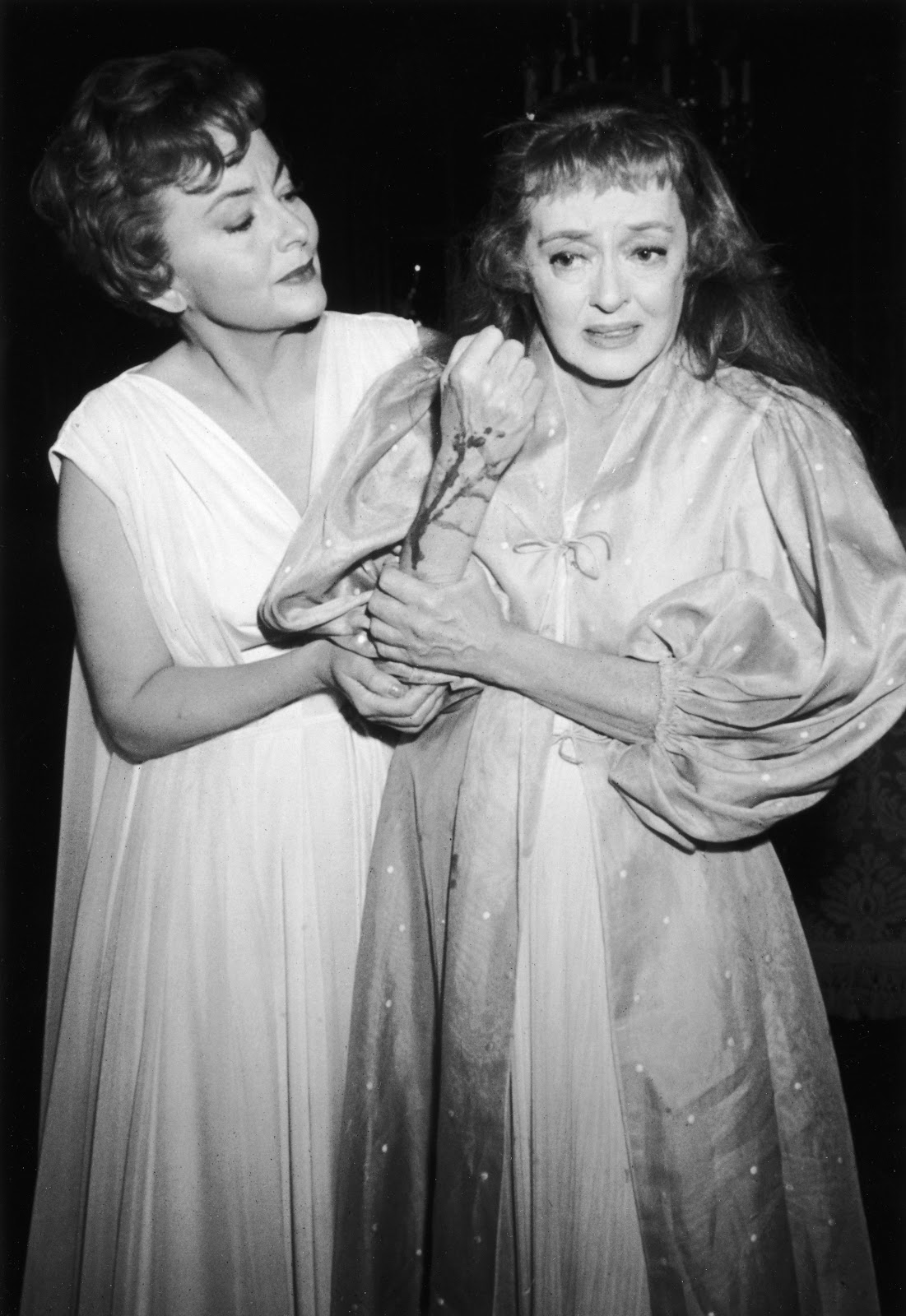
HUSH ... HUSH, SWEET CHARLOTTE (1964)

Robert Aldrich’s 1962 horror thriller Whatever Happened to Baby Jane? single-handedly spawned the psycho-biddy subgenre by successfully blurring the thin line already dividing the gossip column-generating heat of off-screen rivalries indulged at the time -- largely for publicity purposes -- by its two ageing Hollywood stars, Bette Davis and Joan Crawford, and the murderous, co-dependent animus that drives the unstable characters they play to extremes within the context of the film itself. The imaginations of movie audiences were galvanised by the histrionic performances delivered by these rival ‘Grand Dames’ of the silver screen amid the feverish atmosphere of stifled Gothic melodrama Aldrich was able to generate from Lukas Heller’s adaptation of Henry Farrell’s source novel. It was inevitable a second pairing of the veteran star actresses and the independent director would become a much sought-after commodity in the wake of the unexpected box office success and the five Academy Award nominations picked up as the fruits of their first collaboration, and so when Hush … Hush, Sweet Charlotte (1964) came along, 20th Century Fox must have been banking on the chance to considerably up the ante on its Warner Brothers-distributed predecessor, as Heller and Farrell sought to recombine their talents in the cause of helping Aldrich bring to the screen an unpublished sort-of semi-sequel short story (originally titled, with obvious self-awareness, Whatever Happened to Cousin Charlotte?) that Farrell had written to be made as another one of Robert Aldrich's independent productions, but on a considerably larger budget than had been available for Baby Jane.  


For reasons now more widely understood (and which furnish a great deal of the ample background material one will find related in fascinating detail by Kat Ellinger and Glen Erickson across the two commentary tracks included with this new Masters of Cinema release), the proposed ‘rematch’ between Davis and Crawford never materialised, Crawford’s supposed health issues apparently necessitating her removal from the production. Fascinating production stills, taken during the shooting of now-missing footage shot before Crawford left the picture, and which show the actress made-up and appearing in character as Miriam Deering, do still exist and display her very different take on a role that was eventually filled by Davis’s colleague Olivia de Havilland. Instead, free of the constant circus of speculation that surrounded the relationship between these infamous Hollywood rivals, Hush … Hush, Sweet Charlotte emerges as nothing so much as a lavish-looking Southern Gothic spin on the mini-Hitchcock thrillers that Hammer Films had been knocking out on a regular basis for some time by this point, a cycle which had started with Jimmy Sangster’s screenplay for Seth Holt’s Taste of Fear in 1961. Convoluted Gaslight mimicking narratives and endless permutations on the plot to Henri Georges Clouzot’s Les Diaboliques are what drive most of these films, and Hush … Hush, Sweet Charlotte turns out to be no exception, despite being much more handsomely mounted and exquisitely photographed than anything Hammer -- for all the studio’s brilliance -- could ever have hoped to replicate, even in its heyday.


With its generously sprawling 133-minute full feature length, Hush … Hush, Sweet Charlotte has more than enough time on its hands to cover quite a few other bases as well: among them out-and-out exploitation and shock imagery. The film racked up an impressive seven Academy Award nominations. But it’s a safe bet to assume that no other Oscar-nominated film in 1964 (and not many others thereafter) featured explicit shots of limbs being bloodily lopped off with a hatchet, or a decapitated head tumbling down a spiral staircase in an antebellum-era-built Louisiana mansion: just two of the film’s main selling points amid a whole suite of gloriously torrid horror theatrics initially disguised by the film’s prestigious cast of Hollywood greats and beautifully lush Southern locations. The film is intentionally constructed from a vast mosaic of cinematic signifiers which are deployed in this case to enable it to straddle the murky grey area that separates B movie hokum from the Hollywood prestige project without ever having to come to a decision about which of these modes should ultimately get to define it. The screenplay is seemingly precision-tooled to evoke every Southern Gothic motif under the sun and, more pertinently, details of narrative, production design, art direction and even the actual casting, conjure at every turn formless ghosts that hint at many instances of Hollywood’s representation of the Deep South on film: having Bette Davis play a fading Southern Belle traumatised by an incident from the past that robbed her of her one chance at happiness might be assumed a  reference to the kinds of roles the actress played in her younger days, when she was quite often cast as characters from a similar milieu, such as in the 1938 film Jezebel, for instance; while casting Crawford’s replacement with Gone with the Wind star Olivia de Havilland simply reminds the viewer that Davis also lost out on the role of Scarlett O’Hara to de Havilland’s co-star Vivian Lee.


The film begins with a 1927-set prologue that initially plays like a stage-bound scene from some sultry Tennessee Williams play or other: two characters on a single set confronting each other over the heavy oak desk in the study of formidable Louisiana plantation owner 'Big' Sam Hollis (Victor Buono) on a hot summer night in New Orleans, strains of jazz discernible in the distance from a party that’s in full swing elsewhere in and around the colonnaded mansion and its oak-studded grounds. Baby Jane star Buono’s interlocutor is the young Bruce Dern -- here in an early role following a brief appearance in Hitchcock’s Marnie the year before – who is tasked by the screenplay with the plot-instigating duty of getting himself blackmailed and then becoming an instant murder victim, whose death thereafter haunts the central character for the rest of the film. His name is John Mayhew: the married lover of Hollis’s young daughter Charlotte (Bette Davis). The couple had been planning to elope together on this very night, but their plans have just been exposed and thwarted after Mayhew’s wife Jewel (Mary Astor) somehow got wind of it and told Charlotte’s father. Under pressure from the overbearing patriarch, Mayhew later that night breaks off the elopement with Charlotte in the summer house, leaving her heartbroken. Not long after he is dispatched in the grisly fashion already alluded to. The young Charlotte Hollis, the lower portion of her party dress stained red with her lover’s blood, then wanders semi-comatose into the crowded ballroom of the Hollis mansion, confronting her father and all his guests with this menstrual symbol of the family shame.


Did she kill Mayhew or was the deed done by her overbearing father? Thirty-five years later and the locals of Hollisport continue to debate the macabre legend which has grown up around the lurid events that took place in the home of the reclusive Charlotte Hollis all those years ago. The ageing occupant now lives on the site of the former plantation like the Miss Havisham of Baton Rouge: quite alone apart from her dishevelled housekeeper Velma (Agnes Moorehead) who devotedly tends to her needs and sees off any troublesome trespassers. Pining for her dead love, Charlotte Hollis is believed by most to be mad; children might dare each other to sneak into the old mansion at night, but those who attempt such a feat are liable to find not an axe murderer but only a disorientated old lady in white, still clutching at a box that just might contain the head of her dead lover … or perhaps, maybe, it's the music box Mayhew gifted her thirty years ago, that plays the song he wrote for them both. There is the common suspicion within the community, though, that Charlotte herself was Mayhew’s murderer, and that she has been protected from punishment all these years by her late father’s influence and power, which still seems to exert itself from beyond the grave even now.


The fabulous location exteriors used for Hush … Hush, Sweet Charlotte play an instrumental role in imbuing the film with the requisite sense of faded historical grandeur, crucial in conveying the latent idea that sins of the past once obscured by these stately residues of a supposedly more genteel age are only now being exposed to light again, as the past crumbles or is forgotten. The plantation owners of the 18th and 19th centuries built their grand homes with those imposing upper balconies and columned porticos, in a neo-classical Greek Revival style intending to associate themselves with the great splendours of a former European civilisation. But the history the architecture of the Antebellum now represents to most of us is, of course, also marked by a darker side: the fact that its beauty was founded on the prevalence of slavery as a tool for economic dominance and social oppression. Charlotte Hollis lives in an anachronistic museum commemorating the historic brutality of this ‘golden’ age once presided over by her late father and his immediate ancestors, and given actual form in the historically preserved location of the 1840s plantation house Houmas House in Burnside, Louisiana that was used for the exteriors -- one of the grandest of its design. In the present day, Charlotte has herself practically become a ghost from this vanished age. Never having come to terms with the belief that her father was responsible for John Mayhew’s murder, she remains frozen in the shock and grief of that immediate moment from all these years ago, only being spurred into action when her family home is threatened with demolition to make way for a new highway. Even more ambiguous a commentary on the shadow of the past is a scene that comes halfway through the film, in which the kindly insurance investigator who takes pity on Charlotte, Harry Wills (Cecil Kellaway), takes tea in the grounds of the house owned by Charlotte’s great rival, the ageing Jewel Mayhew (Mary Astor), and talks with her about that fateful night many years ago when Jewel’s philandering husband was decapitated in the summer house at the Hollis mansion. Aldrich uses as the backdrop to their talk the picturesque sight of a canopied oak allée from the Oak Alley Plantation in Vacherie, Louisiana: a location so exquisitely designed to fit a romantic view of the past one would almost have assumed it to be a matte-painted background created specifically for the purpose of conveying that impression. The film is all about the prevalence of masks, and the most deceptive mask is the mask of nostalgia: it cloaks all manner of ills in the soothing afterglow of best intentions and whitewashed motives.      


While the historical authenticity of the exterior locations allows the film to become infused with an atmosphere of stately decay and moral ambiguity, the studio-created interiors and the way they are staged, dressed and shot by Aldrich and his repertory company of regular crew members, attest to the continued potency of Gothic horror and its macabre genre offshoots. Art director William Glasgow and cinematographer Joseph Biroc are primarily responsible for creating the rich velvety high-end noir atmosphere enveloping the ornate décor of Hollis House, while costume designer Norma Koch puts the older Bette Davis in platted pigtails and flowing nightgowns to emphasise how the character of Charlotte is trapped in her youthful past even as she plays out the role of a traditional Gothic heroine. Davis gives another committed full-throttle performance that holds nothing back: she may not get to be as demonstrably evil-hearted as she was in Baby Jane but a good portion of the film requires her to inhabit various stages of insanity as visitations and hallucinations of severed heads bouncing down the staircase and-the-like begin tormenting her one by one, as does some ghostly harpsichord music that plays in the night and an encounter with faceless guests in a dreamlike slow-mo ballroom sequence recalling her last night with Mayhew. Frank De Vol’s music once again strikes a fine balance between saccharine irony and sweeping melodrama, particularly on the title song (a rival to Baby Jane’s I’ve Written A Letter to Daddy) which serves multiple roles in the film: one minute functioning as the creepy music box motif associated with Charlotte, and the next as an eerie harpsichord air to signify her final descent into madness. It later also transformed itself chameleon-like into a pop hit of the day for Patti "(How Much Is That) Doggie in the Window" Page!


Davis’s florid performance is complemented by an equally robust comic turn from Agnes Moorehead, as muttering maid Velma. A fine character actress who at the time would have been best-known for playing Samantha’s mother Endora on the TV series Bewitched, Moorehead's career stretched back to the 1930s when she did a stint with Orson Welles’ Mercury Theatre troupe, performing alongside Joseph Cotten, who now joins her again in this film for a smallish role as Charlotte’s doctor, Drew Bayliss. As the former lover of Miriam Deering, Cotten delivers the required levels of sliminess in a role originally slated to have him play most of his scenes opposite Crawford but which eventually saw him working with Olivia de Havilland instead. The couple’s relationship dates back to the time of John Mayhew’s murder in 1927. Bayliss broke it off back then with Miriam because of the scandal associated with the Hollis name in the wake of Mayhew’s death -- meaning Miriam is returning to a site that holds painful memories not just for cousin Charlotte but for her too. Those memories are made all the more tangible when Miriam comes back to Hollisport at the request of her cousin after years living a metropolitan life in the big city. Charlotte wants her to help in the fight to oppose the building of the highway on the site of the Hollis mansion, but Miriam returns to find that, forty years later, her old lover Bayliss is still the acting family physician. While everyone else appears to be trapped in an emotional time warp by the events of forty years ago, Miriam comes across as a stable, level-headed person who is being forced into confronting the tumult of her past against her will. But of course, this being a Gothic-themed thriller, with all the twists and turns that entails, the truth of the matter proves to be a great deal more complicated. Olivia de Havilland is probably a much better casting choice in that regard than Joan Crawford would have been, since she initially exudes an air of normalcy that makes her a viewer identification figure from early on in the movie: a witness to the madness, eccentricities and abnormalities of all the other characters, and a good steady foil to the exaggerated flightiness of Davis’s character. As the plot unfolds, a harder edge emerges to her Miriam Deering and one of the film’s major strengths lies in the way de Havilland manages her character’s transition from apparently innocent bystander to the prime instigator of some pretty fiendish events. The plot itself might not contain anything truly surprising, and is pretty much boilerplate thriller material but de Havilland gives a fully rounded performance that holds the attention throughout, while Aldrich manages to sell a whole plethora of deranged, surrealistic sequences in the second half that makes the ride entertaining even if we’re never truly in any doubt as to the eventual destination.


Hush … Hush, Sweet Charlotte was always a handsome-looking film, and it finally gets a fitting 1080p HD presentation for this UK Blu-ray release from Eureka Entertainment as part of The Masters of Cinema series. A 22-minute archive ‘making of’ featurette contains all the basic background production facts on the film, and Bruce Dern provides a nice 13-minute interview in which he recalls his interactions with Bette Davis on set and behind the scenes. There’s also a brief 5-minute contemporary set report narrated by Joseph Cotten. But the two stand-out commentaries are the main centrepieces of the extras package included here: Kat Ellinger once again proves her worth with a well-researched track that takes a thoughtful look at, among other things, Robert Aldrich’s relationship with the ‘women’s picture’ and the cross-over he forged with noir and Southern Gothic. Meanwhile, Glenn Erickson provides a more traditional overview, concentrating on biographical info about the main cast and crew members. Both contributors tackle the Joan and Bette feud and the drama of Crawford’s replacement by de Havilland, each managing to bring an individual take to the business without contradicting the other on the basic facts. Trailers and TV spots are included, and this Blu-ray only release also comes with the traditional collector’s booklet, this one featuring a new essay by Lee Gambin illustrated with some fascinating archival imagery.


Hush … Hush, Sweet Charlotte is a gorgeously overwrought piece of Gothic melodrama and a fine example of the mid-sixties ‘twist in the tail’ thriller. It has some great performances from usually side-lined older actresses, while the likes of Joseph Cotten, George Kennedy and Cecil Kellaway are this time relegated to supporting roles. Aldrich gave what could have been considered relatively trivial by-the-numbers material his full directorial attention, creating a lush spectacle of Gothic madness that delves into all manner of twisted psychological unpleasantness with a wilful glee. The cast of Hollywood greats at its centre seems to have been more than happy to follow Aldrich wherever he may lead them, in what has turned out to be a much-overlooked gem of the genre.    

Saturday, 17 February 2018

THE HOUSEMAID (2016)

It is no surprise that colonialism should have such an important role to play as the thematic lynchpin in Derek Nguyen’s debut feature The Housemaid (Cô Haû Gaí). The film, set in Vietnam in 1953 during the French Indochina War, positions itself as a traditional Gothic romance, a genre with many established literary antecedents in the 19th century that set a textual precedent for dealing with issues that arise from the fact of colonialism and the social dynamics of Empire -- including Charlotte Brontë’s Jane Eyre, or even Mary Shelley’s Frankenstein. When it comes to the Gothic in cinema and on screen, none have mined the post-colonial guilt of a faded empire nation more effectively than Britain’s Hammer films in the 1960s and ‘70s, especially when it could find ways to combine the theme with Freudian notions of the return of the repressed; for example, in the sexually charged exoticism that underscores Jon Gilling’s The Reptile. However, Nguyen’s approach to the Gothic and to colonialism have much more in common with the work of Guillermo Del Toro in his films The Devil’s Backbone, Pan’s Labyrinth and, more recently, Crimson Peak which set creepy, fantastical goings-on in a closed location defined by a particular milieu, and use familiar tropes related to the Gothic genre to provide metaphorical context and commentary on specific historical events.

Writer-director Nguyen was born in what was then Saigon (now Ho Chi Minh City) in 1973. His family left South Vietnam for the United States two years later, along with 130,000 refugees who also fled the country during the US evacuation, fearing retribution from the forces of the invading North Vietnamese. In The Housemaid, Nguyen reaches back several decades to before the Geneva Accords and the ensuing communist insurgency, to when the Viet Cong’s predecessors, the Viet Minh, were fighting a war which had been raging since 1946, for independence from French colonial forces. The complexity of the historical detail matters little to the arc of the story but is used merely to provide an anchor for a tale that seldom strays beyond the borders of a once grand but now gone-to-seed French colonial estate on the grounds of a rubber plantation hiding a very dark and violent history of abuse and oppression. This decaying mansion and the forbidding forest of rubber trees on its outskirts provide all the Gothic menace one could hope to derive from such a tale, as Nguyen turns for his Gothic model to a recent successful update of the recipe that recently helped revitalise Hammer Films: namely the 2012 adaptation of The Woman in Black


Originally, that story took the form of a novella by writer Susan Hill, and aimed to capture the essence of traditional fireside ghost stories like those that once might have been told by M.R. James to his Cambridge students over a glass of Christmas sherry. For the updated film iteration, imagery and more forthright jump-scare techniques borrowed from modern J Horror were also brought to the table. This is the style The Housemaid slavishly seeks to imitate, although after commencing with a strong but imitative prologue that reproduces a vision of the threating, darkly veiled spectral entity familiar from the source of its inspiration, the film later drifts into waters apparently more sedate, but with a stronger focus on areas of dark romance and sexuality. It becomes a fable-like exploration of the unequal but ambiguous erotic power dynamics that lie behind the master and servant, oppressed and oppressor relationships so intrinsic to a colonial set up, but will probably mystify or bore western horror fans who aren’t also up on their Poe or Daphne Du Maurier -- although this aspect of the tale doesn’t appear to have harmed its reception at home. However, this "third-highest-grossing horror film in Vietnam’s history" (a nice publicity line, but how many horror films from Vietnam have there actually been?) can’t resist for long the urge to unleash its own budget version of a ‘kitchen sink’ finale, as the last act presents a veritable torrent of enjoyably over-the-top pyrotechnic set-pieces and unlikely plot twists in a bid to hold its own with contemporary western fright flicks along the lines of Insidious or The Conjuring and its ilk. 


Nguyen’s screenplay admittedly does an impressive job, though, of outlining a very specific period in Vietnam’s history and making its content perfectly fit the well-defined contours of an utterly conventional ghost story cum Gothic Romance. The film’s nervous young orphaned heroine, Linh (Kate Nhung), arrives at the Sa-Chat estate on a suitably stormy night, looking for work as a housemaid after her family has been killed in air raids that wiped out most of her village. Austere head housekeeper Mrs Han (Kim Xuan) and an affable cook who claims also to be a witch (Phi Phung) are the only occupants of the otherwise-empty mansion, which is being preserved like a museum relic until the eventual return of its master -- currently away fighting communist guerrillas as an officer in the French army. Meanwhile brooding groundskeeper Mr Chau (Kien An) lives alone in one of the outer huts on the rubber plantation formerly used to house the French overseers who once made life a misery for the poor indigenous workers tricked into coming from all over the country to toil on the estate on the promise of good wages and a decent place to live. 


The estate’s dark history is defined by its troubling mixture of public exploitation and a very private, domestic form of grief: the imperialist cruelty and violence meted out to the plantation workers and their families – in the form of whippings, beatings and rapes – exists alongside the mental disintegration behind closed doors of the French estate manager’s tragic wife Madam Camille who, suffering from post-natal depression, reputably went mad with loneliness when her husband was called away to fight in the war: she drowned the couple’s baby in the bathtub but continued long after to administer to its rotting corpse in its crib, until finally drowning herself in a nearby lake. These macabre legacies of Empire (according to the kitchen cook, who tells Linh all about them) each leave their own imprint on the house and its surrounding grounds: Madam Camille’s black-shrouded ghost apparently haunts the hallways, staircases and recesses of the now-neglected mansion; while the spirits of the many hundreds of workers, murdered when the war for independence first broke out, allegedly now wander the forest of rubber trees under which their bones still lie buried in hidden mass graves.


The first act establishes Linh as a new and disruptive presence at the empty Sa-Chat estate -- with its grisly retinue of stirred up secrets and its still-uncertain future -- and falls into a pattern familiar to many traditional spook fests in which long, slow, moody sequences, where the young housemaid explores the mansion’s dark corridors by lamplight, are followed by the tension-release of a sudden jump scare. This is where the film is at its most Woman in Black-ish, with briefly glimpsed ghostly figures swishing into the frame, just beyond the protagonist’s eye-line as she wanders rooms and landings designed to showcase lush production design and set dressings highlighting a mix of Vietnamese and Western architectural and ornamental influences. These early forbidding explorations of Linh’s are also disturbed by the hollow, echoing, insistent cries of an unseen mewling baby, heard in some far-off, unidentifiable section of the house; and the inexplicable sight of a self-rocking crib, swathed in cobwebs, from which grabbing phantom hands suddenly emerge … only for Linh to wake with a fright from what turns out to have been merely a haunting nightmare. 

Such imagery is throughout complimented by Sam Chase’s rich and deeply textured cinematography, layering evocative details -- like the House of Usher-style family portraits lining the walls of Sa-Chat, or the estate's imported 1920s furnishings, both of which subliminally remind one of its rootedness in French imperialism -- in a blossoming mantle of atmospheric gloom and shadow seen enveloping the storm-lashed mansion. The estate's mix of east and west influences on its interior design can arguably be seen as a metaphor for the film itself, which has its own mosaic of influences that take on the history and unique geography of the regional setting and use them as the basis for an exercise in pure mainstream genre filmmaking that relies on story beats and filming techniques for its stylistic dressing that are indicative of the popular western forms of cinema its US-raised writer and director grew up on.


The middle section of the film is based around what happens when the estate’s French master, Captain Sebastien Laurent (Jean-Michel Richaud), turns up out of the blue, badly wounded after being ambushed by independence fighters, and in need of urgent medical assistance. He and his family have always insisted that local customs, such as the beliefs and practices of Eastern medicine, be ignored as a matter of principle and, in defence of that stand, Mrs Han forbids the witchcraft-practising cook from administering any of her potions and spells while they wait for a western doctor. However, when Han is called away to visit her sick mother, leaving Linh in charge, the young housemaid feels unable to resist when the Captain’s condition deteriorates to such an extent that death seems certain, and cook persuades her to let her try her own methods as a last resort. Here the film takes a detour away from the suggestive atmospherics of a traditional Gothic ghost story and into areas of more outright fantasy horror, as the cook’s ritualistic spell to accompany her remedies not only facilitates a miraculous recovery in the Captain, but appears also to raise the zombie-like cadaver of Madam Camille from its watery grave! 

This development (as well as the ensuing instances of poltergeist-style activity inside the mansion) at first suggest we are about to be given a straight up rollercoaster ride of spectacle-based horror, but instead the story slows down to become almost exclusively centred on a developing romantic relationship between Laurent and Linh. When the two remaining impediments to the couple embarking upon a full-blown romance – namely the cook and Mr Chu – leave for their annual holiday and hand the house and estate over to the sole care of Linh, she gradually goes from being nurse and carer for Laurent to becoming his lover, which eventually leads her to the role of mistress of the house. By the time a disconcerted Mrs Han and the others have returned, Linh has fully replaced Madam Camille in that role!


Here the film indulges in a minute examination of the shifting power dynamics at play in the relationship, making plain the exploitative aspects inherent to this historical context, and the social obstacles likely to crop up for the two lovers, which are looked at from both sides. When Laurent’s army colleagues visit the estate, they view Linh as almost subhuman; one of them even attempts to rape her – forcing Laurent to stop turning a blind eye to his countrymen’s abuses and put his cards on the table, renouncing his affiliates by kicking the group out in a fury. An even greater choice has to be made when Laurent’s English fiancée Madeline (Rosie Fellner) turns up wishing to resume their broken alliance, which leads to the melodrama of a bitter love rivalry that cuts across both class and racial barriers. 

But other class-related complications occur for Linh, too, when her employer Mrs Han returns, only to find that it is she now who has become the employee, while her former housemaid is now the mistress of the estate and her boss. Both Laurent and Linh have to face the accusation from their respective social peers that they have become “the enemy”, with Linh also having to confront the same predicament as that which once faced her predecessor, when she falls pregnant just as Laurent is about to be called away again to fight. There’s some justification to accusations that the apparent departure from straight ghost story and more upfront horror content for large stretches of the middle section of the film results in a slowness of pace, but the issue of the threat that the relationship poses to Linh’s cultural identity and the questioning of her suitability and authenticity in the role she has been called upon to assume at Sa-Chat is eventually explored through a possession subplot kicked off when Laurent opens up his former wife’s wardrobe to Linh in order to help her look more comfortably the part in her new high-status role.


There is eventually a huge twist to come that makes use of unreliable narrator tricks that are based on an ambiguity that's inherent to the status of the point of view from which we’ve been following these entire events; and the final act turns into something of an Evil Dead styled supernatural bloodbath, as bodies start piling up at the hand of the revenant Madam Camille, while the rotting corpses of the dead also rise up from their plantation ossuary in scenes highly suggestive of similar ones that were depicted in Lucio Fulci’s Zombie Flesh-Eaters. Scary pay-offs such as these ensure the film eventually delivers on its early promise, but it will be the fans of more traditional gothic fare who will be most likely to appreciate the thoughtful ruminations that lie at its heart, on the possibilities (or lack thereof) of rapprochement after colonial rule and the privations of war. This is an accomplished feature debut, with strongly committed performances from the small but convincing cast. It’s well worth a watch and is currently available in the UK on the Montage Pictures label, a sub-division of Eureka Entertainment, in a dual format double-disc edition with no extras.