Flesh-eating zombies may
never be likely to take over the world for real, but they have certainly
dominated the horror genre for some considerable time now, and the infection
shows no sign of easing up its widespread virulence as the plague continues its lethal
march across the landscape of international horror, consuming all that fall in its path as it rapidly jumps
host and moves from film to computer games, converts the world of graphic
novels and now moves on to its most recent acquisition, TV drama -- which takes the form of AMC’s hugely
popular The Walking Dead, which was based on Robert Kirkman’s popular comic
book series. This multi-platform dominance has been accomplished with apparent ease and equal success. One of the most heavily
susceptible species of media, especially prone to harbouring a particularly unshakable variant
of this most persistent of infections, has long been recognised to be the no-budget independent feature.
The living dead have planted themselves firmly in place and taken root
in that film backwater, as a permanent fixture that shows little indication of
being supplanted anytime soon: all any aspiring Fulci needs these days, after
all, is a camcorder, a little bluish grey face make-up and an "extra" or two
happy to moan incoherently and affect a shambling gait for the viewfinder (and if they have no
objection to chowing down on some raw butchers’ guts, all the better), and his/her film career is up
and running!
Of course, very few of these flicks -- the vast majority of which are customarily proven to be amateurish dreck of the first order -- are worth even the
effort it takes to insert the disc into a DVD drive, yet still they keep on coming
by the dozen, dominating the landscape through a persistence of numbers that eventually
makes them impossible to hold out against as they continue their mindless mission to fill DVD bargain
bins in never ending bulk supply.
The zombie sub-genre remains popular of course (which
partially accounts for this abundant harvest of flesh-eating variants) and it
still occasionally but regularly supplies interesting material; yet one can’t help
but be aware of the poverty of imagination which ultimately lies at the root of
the ubiquity of the phenomenon. Yet, if there’s one interesting thing to comes out
of a recent collection of zombie-based indies, released in the UK as a
double-disc set by Monster Pictures (distributed by Eureka Entertainment), then
it’s the set's inadvertent highlighting of the fact that the zombie sub-genre is actually capable
of sustaining an incredibly wide selection of divergent approaches, and there are a
spectrum of distinctions to be made, even within the indie movie bracket alone. Of course, the
term ‘indie’ also covers a multitude of budgets and standards of professionalism,
but rest assured -- everything included here meets a certain core level of
competence (in other words, there’s nothing included in this set that is a complete
insult to your eyes!), whether it be shot for tuppence on DV or aspires to widescreen
cinematic standards of presentation. Across two discs, we’re given over five
hours’ worth of zombie shorts from all over the world and in all sorts of styles,
incorporating comedy, romance, action, satire and even the odd existential
meditation. Although it’s an obvious PR line to take, there is indeed something here for everyone: if a
particular short doesn’t happen to do it for you, then there’s every chance that the next one along
will float your boat instead. The shooting standard ranges from grungy indie DV
amateur style to comparatively glossy-looking fare. And there’s even a puppet animation
zombie western here as well! The variety extends to running time, as we're given everything from brief five minute vignettes to hour-long mini features, with most entries averaging around fifteen minutes in length.
Dutch directing duo Barend de
Voogd and Rob van der Velden demonstrate versatility even with the simplicity
of their opener’s minimalist set-up: Zombeer(2008, Netherlands, 11 min) is an initially slick comedy short that highlights what
happens when a bibulous brewer at a high-tech distillery keels over and drowns
in a huge vat of his firm’s finest booze (‘beer with a bite’ is the company’s
apposite tag-line!). Not only is the dead man (Rogier Schippers) reanimated by
a secret mixture that’s being stirred-up in the bowels of the brewery, but
everyone who samples it (which includes a party of Japanese day trippers) instantly
becomes a flesh-craving revenant too. This quickie spans the gamut of the
zombie sub-genre’s stylistic traits: starting off as a fairly proficiently
filmed piece of work before moving into a (presumed) parody of [REC] by having most of the climactic
zombie action shot as found-footage, viewed from the POV of the shaky camcorder of one of the
fleeing visitors to the brewery. Similarly, Zombies and Cigarettes (2009,
Spain, 17min), also directed by a
duo, Inaki San Roman & Rafa Martinez, takes the most familiar scenario
imaginable – a zombie outbreak in a Spanish shopping mall which leads to a small
group of survivors barricading themselves against the hordes – and uses it as something of
a director’s show reel: it’s extremely well-shot and sharply edited, and it has gathered a
raft of festival awards including some for best visual FX and best director.
One can see why its flashy slickness would attract such attentions ... it may be
the least original of any of the films included here, but it does at least attempt
something interesting and new with the bitter-sweet cynicism of its conclusion, and the brief running time is perfectly judged for preventing it from outstaying its welcome.
Zombies and Cigarettes (2009) Spain
Joseph Avery and Matt Simpson’s
Plague
(2008, UK, 17 min) heads for
more obviously satirical waters in a grungy tale about an illegal migrant and gun-runner who flees the troubles of his Latvian homeland and winds up in a London that’s
become overrun by the living dead. This sombre tale of urban isolation and
despair makes fitting use of the zombie metaphor to examine the alienation, loneliness
and persecution suffered by those forced to make a life for themselves in the jostling
metropolitan sprawl that is contemporary London by removing the "jostle" and the "sprawl" and
leaving only the apocalyptic decay of the aftermath of zombie plague. There’s
one affecting and atmospheric scene in the middle of this piece which occurs
when the narrator and protagonist investigates a derelict building, resulting
in one of the most well-executed scare scenes to grace any of the films in the
set. Duncan Laing’s Bitten (2008, UK, 6 min)
is another downbeat effort with an intriguing and disturbing premise. Here we
join a young woman, played by Claire Wilson, in the middle of a zombie infestation and
after she has just been bitten and is awaiting her own imminent transformation
in the familiar surroundings of her home. Tense, ugly and grim, this is a fraught meditation on
the prospect of the loss of one’s own faculties -- a situation which, frankly, will face us all
in some form or other eventually. It combines gruelling body horror with a thought-provoking
contemplation of mortality, and is only let down by poor "pancake" zombie face make-up,
which rather breaks its spell. Another low budget effort, Arise (2010, USA, 18 min), attempts to excuse
its own shoddy splatter effects with recourse to a facetious line in silly humour. The
annoyingly cliched Death Metal soundtrack and the deliberately bad gore which accompanies
all the "action" throughout risks losing the goodwill of the viewer fairly quickly, but this
does actually have a thoughtful payoff about parental responsibility and maturity behind
a long line of suppurating zombie cadavers shuffling forth to be deprived of
limbs when the hero’s proficiency with his work tools finds another use after the living dead
invade his workshop. Not
Even Dead (2009, USA, 5 min)
examines the misguided urge to hang on to a loved one and hope that a cure can eventually be found for
the zombie infection: David (Joseph Will) keeps his zombified wife(Treva Tegtmeier) chained up in
the basement and illegally feeds her, convinced there is still some remnant of
the woman he used to know preserved inside the salivating creature’s brain.
This is a bleak little tale about the catastrophic repercussions of irrational,
undying love. Unfortunately, well-enough staged as it is, it just doesn’t go anywhere you don’t already expect it to go to.
Bitten (2008) UK
Randy Smith’s Fear
of the Living Dead (2009, USA, 16
mins) is a cheaply shot attempt to do action and mystery with a small cast
and a tiny budget and never really gets convincingly off the ground. April Campbell plays a young woman who believes she is the
last woman left on Earth thanks to her immunity to the zombie virus, which has
turned the rest of the world into flesh-craving ghouls. However, while raiding
suburban houses for supplies she finds she isn’t the only remaining human being
who's out and about after all. After becoming well-used to living in "survivalist" mode, this discovery becomes a difficult
circumstance to adjust to. But she may well now be in even more danger than ever before.
This is watchable enough as far as it goes, but it’s too slight and
cheap-looking to pass muster as anything else but a minor quickie. Kidz (2010, Canada, 9 mins), on the other hand,
is a delightful comic vignette in which a trio of child friends prove to be well-equipped
for the death of their parents during a zombie plague because of their well-honed proficiency at shoot-em-up video
games. Approaching the entire ordeal as just another game, they suit up as super-powered
comic heroes and set about protecting the neighbourhood from the encroaching
zombie hordes. Nicely acted by the young leads, this combines zom-com humour
with a gentle evocation of the nostalgic joys of childhood fantasy and play.
Kidz (2010) Canada
The Book of Zombie (2007, USA, 64
min) is, of course, the most substantial work here in terms of running time,
and thus it’s no surprise that this is the one which most successfully manages
to build up some degree of character interaction, which helps to create and hold on
to viewer interest. A troubled married couple (Brian Ibsen and Larisa Peters) attempt to
bond on Halloween night while their daughter is away having a sleepover with
friends, but the evening is already going far from well for their relationship when
the couple are suddenly assailed by zombie Mormons at their door who have taken
over the small sleepy Utah town in which they live. As they battle through the
streets to reach their daughter, they meet a couple of stoned and slightly
vacant slacker youths working late in a local store, and the group attempts to hole up in
a Medieval themed bar with a feisty waitress who’s got her zombie boss locked
up in the store room. The conceit behind this gory comedy is that only Mormons
are initially affected by the zombie infection, and they can only be stopped by
exposure to caffeine (Mormons won’t touch anything that contains it, apparently),
which is most readily available to our heroes in the form of soft drinks sold in the
store they find themselves barricaded in (one character meets his end when his
defensive can of Coke turns out to be of the decaffeinated variety!).
The Book of Mormon (2007) USA
Andrew
Loviska puts in a decent effort as the laconic, bespectacled slacker shop clerk
Darwin, and Ibsen and Peters make their initially annoying bickering couple (who
are gradually brought closer together over the urgent need to kick some serious
Mormon zombie butt) more and more likable as the film proceeds towards its
Evil Dead-style splatter-based finale. Not quite so likable in the comedy stakes is the British
effort from Sat Johal, Tony Jopia and John Payne: Zombie Harvest (2003, UK, 11 min) starts with someone tripping over while trying to
escape from a zombie revenant by running through a farm, and ending up with their head
stuck up a cow’s arse; things go pretty much downhill from there on. A few nice
shots near the end, of a ghostly army of the re-animated dead shuffling, like
rotted Fulci-esque cadavers, through a cornfield in the Oxfordshire countryside,
is small compensation for this facetiously narrated tale which is told from
the viewpoint of a soldier from a nearby American base, who’s on the turn after being
attacked by a scientist who's been experimenting on himself with a genetic virus that has had some unforeseen
consequences.
The Skin of Your Teeth (2009, USA, 14
mins) is more a vignette than a fully-fledged short, and ends up leaving the
viewer wanting more. But in terms of atmosphere and creepiness it’s by far the
most successful piece included in this collection and is actually my favourite.
Shot on a working farm in Western New Jersey by Dan Gingold -- a
director/producer/editor based in Brooklyn, New York -- the film expertly uses
landscape and space to create a mood of forboding which has a Cormic McCarthy-style sense of impending
doom about it. The dialogue is kept to an absolute minimum and the set-up is conveyed
visually, as we are introduced to a quartet of young survivors from a recent
zombie plague taking refuge in a derelict farmhouse on the brow of a
hill surrounded by a flat expanse of countryside. The group monitor emergency
radio broadcasts for news and keep watch for the approaching hordes from the
roof of the farm building using binoculars. The film vividly evokes a sense of
dread relying on the featureless landscape as a means of emphasising the fact that
there is nowhere to hide, and when the zombies eventually do come, the frantic battle
for survival is by far the most visceral and scary out of this bunch of films because of this acrophobic
feeling of the vastness of the countryside that the dead are seen to now dominate. Poor
zombie makeup may slightly let the side down, but the last few minutes are the
most terrifying out of any of the shorts here.
The Skin of Your Teeth (2009) USA
David M. Reynolds’ Zomblies
(2009, UK, 47 minutes) is the
other substantial work included in the set, with its TV episode-like run-time
enabling a proper storyline to unfold rather than just the sketching out of a
mood or the delivery of a set-piece. It’s steeped in the stylistic mannerisms
and tone of 28 Days Later and its ilk, with shaky camerawork and digitally
de-saturated colour tones ... but it sets up its dystopian world quite effectively
and sells the action set-pieces it’s been designed to convey with conviction. There’s
also quite an enveloping score accompanying this action and gore-drenched
apocalypse. This is basically a ‘guys on-a mission’ film in which an elite
squad of Rangers are sent out beyond the automatic-machine-gun topped wall, that
provides a protective perimeter for a high-tech military base with a control
room that looks like CTU from 24,in search of a rookie bunch of
zombie hunters who have gone missing after leaving a distress call. The macho
squad soon find themselves in trouble when it turns out that the zombie virus
is mutating and can infect people even if they’re only exposed to the blood of
one of the dead. There’s nothing wrong with this film other than the fact that
it’s just a straight-down-the-line, low budget version of a typical zombie
action film, with nothing new to offer. Performances are generally acceptable
but characters, as tends to be the case with such material, are simply "types" and
its hard to get more than casually engaged with the plight of the cookie cutter
squad of military men who find themselves cornered and cut-off in a wilderness
of marauding dead, as their superiors decide to cut their losses and bomb the
whole area with their men still in it.
If it’s originality rather
than straight-line thrills and action you’re after then look no further than
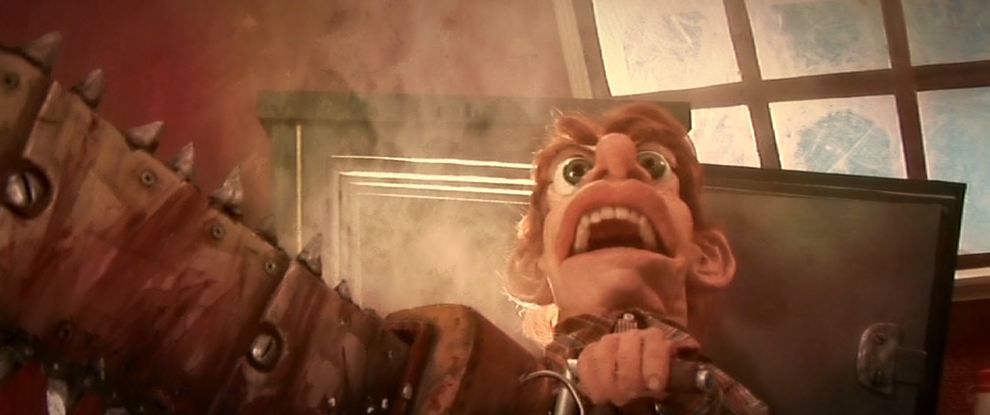
the next offering: It Came from the West (2007,
Denmark, 16 min) is an animated western created with hand puppets and
directed by a 27 year-old student of the National Film School of Denmark called
Tor Fruergaard. It tells the story of a freckle-faced, ginger-haired youngster
with an overbite, called Virgil. Bulled by his oafish father and the mean guys
who prop up the bar at his local saloon, who collectively dismiss him as
nothing but “a wannabe cowboy weak pisser”, this plug-eared hero finds himself
trapped between a rock and a hard place when the daily round of abuse he
suffers at the hands of his daddy and his boorish friends is interrupted by a
good ol’ zombie siege. A serial killer called the Dark Destroyer has been busy
chain-sawing the local redskin population to death, and the natives decide to
strike back by raising the dead in a sacred ceremony to take revenge on the white man. Before the bog-eyed-ugly
cast of totem-faced cowboys have realised what’s going on, the Saloon is
besieged by flesh-eating zombies freshly risen from a nearby graveyard and it’s up to Virgil to fend them off
as the other patrons meet a variety of gory deaths at their undead hands. This humorous
puppet adventure revels in outrageous cartoon gore, quirky characters and a
great score that mixes tribal drumming and some extra twangy tremolo guitar licks.
It Came from the West (2007) Denmark
Gregory Morinhas’ Paris
by Night of the Living Dead (2009,
France, 12 min) takes some stylish cinematography and cartoonish CGI
splatter effects and combines them with fluid camera movement and vertiginous
crane shots to make up this fast-moving action-fest, in which the dead take over
the streets of a series of Parisian tourist destinations and only a
handsome-looking, newly married young couple (Karina Testa and David Saracino)
are available to fend them off when their wedding vows are interrupted by the
zombie outbreak. This twelve minute piece is all about style, with the couple whipping
off their wedding clothes in a trice and producing huge pump-action hand guns
from nowhere (it’s always good to come prepared) before striking a series of
action poses while variously either machine gunning, decapitating or otherwise eviscerating
the staggering zombie crowds. The CGI is pretty low rent, but then that only
adds to the cartoony artifice of the action, and despite the superficiality of
it all, this manages a few tense moments and even a little poignancy at the end.
Paris by Night of the Living Dead (2009) France
Tarunabh Dutta’s Savages
(2011, India, 39 min) is
billed as one of India’s first independent zombie films and the imagery that
comes with its interesting mixture of semi-rural/jungle locations is certainly
different enough from anything seen in the other films included here to make
this fairly cheaply-made effort stand out, although the influence of The Evil
Dead and a few other classic Italian-made zombie films is always
apparent. Unfortunately, the enthusiasm of the participants in front of and
behind the camera is rather fatally undermined by the sheer amateurishness of
the cast performances. This mostly just looks like a bunch of mates having a
laugh with a video camera while they spend a weekend making their own zombie
picture. The story, in which a group of teenagers idly amble off into India's equivalent of the backwoods
on the outskirts of their village in order to give one of their number a special ‘treat’
by taking him on a camping trip to a contaminated area that’s been sealed off as a
biohazard for years, requires said characters to behave with more than the
usual quota of stupidity we expect to find distributed among the cast of zombie
fodder flicks like this. There’s a dishevelled-looking ‘wise man’ who at first tries to
warn them off and then, when that doesn’t work, resorts to martial arts skills
to get rid of them; but by then it's already too late and one of the group gets
infected with the zombie-inducing contaminate with predictably half-arsed
results.
The final film in this
collection, Dead Hungry (2009, UK, 10
min), is the surprise gem of the bunch and is probably best summed up by
its tag line: ‘life’s a bitch, and then you die. Then you’re a zombie, and
death’s a bitch too.’ The unfortunate
protagonist of this little adventure is a forlorn-looking and very hungry revenant
with a rumbling belly who’s in desperate need of fresh brains. Stumbling through
a forest clearing, dressed in baggy dungarees, our “hero” encounters a number
of classic clichéd zombie/horror movie situations but is too generally hopeless
at being a member of the walking dead to capitalise on them. Basically, he’s just
a little bit clueless when it comes to the business of eating people. Director William Bridges deals in a
wry, poignant humour that closely resembles the attitude of Shaun
of the Dead, but here it’s the
hapless zombie we feel for, and his point of view we take throughout this ten
minute film ... not that of the potential victims he’s attempting to make a meal of. When
the classic zombie siege situation develops after a bunch of American teenagers
attempt to take refuge in an old log cabin, it is the poor old hungry zombie outside
whose fortunes we’re actually following, as he continually gets crowded out by
the other more pushy zombies surrounding the trapped kids' hideout, who are also attempting to break in.
Eventually a quirky little ‘romantic’ relationship develops between "our" zombie and another
female zombie who's also taking part in the siege -- and the ironic bittersweet ending
takes the concept of funeral humour to extremes!
Dead Hungry (2009) UK
As a collection, the films included in
this Monsters Pictures releasedemonstrate the full range and the great versatility
the zombie film is still capable of; and although a few of the entries merely deliver
standard zombie flick fare, many others remind us how there is still more than
a spark of life left in the genre’s shambling cadaver, should the more inspired indie writers and
directors choose to search for it. RELEASING COMPANY: Monster Pictures/AVAILABILITY: Out Now/GENRE: Zombie Horror/FORMAT:
DVD/REGION: 2 PAL/ASPECT RATIO: Various/DIRECTOR: Various/CAST: Various
Following hot-on-the-heels of
producer Tony Tenser's first post-Compton production of 1967 (the often
underrated, Michael Reeves-directed Boris Karloff vehicle, The Sorcerers) which came in the wake of his break with former Compton Club partner
and distributor Michael Klinger, this bizarre attempt to emulate the box office success of two
grisly period-set Hammer classics, The Plague of the Zombiesand The Reptile (both of which had been filmed back-to-back at Bray the previous year), also
became the first film to officially sport the Tigon British moniker; it went
into production at the tiny Goldhawk studios in London’s Shepherd’s Bush in the
summer of 1967 (coincidentally, on the same day that Terrence Fisher commenced
shooting the stylish The Devil Rides Out
at Elstree), under its original (and better) title The Death’s Head Vampire, but was eventually held back until after
the release of Michael Reeves’ next Vincent Price-starring project, which
turned out to be the classic Witchfinder General. By this point the film had been retitled with its current, much
more potent-sounding, moniker. (In the US it was to trade under the even more
disreputable-sounding The Vampire Beast
Craves Blood!) In any case, the finished article
initially opened as part of a double-bill with the Italian-shot, black &
white Christopher Lee Gothic vehicle, Castle of the Living Dead, but was quickly overshadowed by the success of Reeves’ critically
acclaimed masterpiece, and promptly paired up with it for national distribution
by ABC's chain of cinemas, though now relegated to support feature status;
even so, this canny pairing saved the day for Tigon’s investment and ensured
that the film didn’t sink into total obscurity. The Blood Beast Terror has not exactly gone on to enjoy a
particularly distinguished reputation since then, with even its lead, the great
British horror star Peter Cushing, damning it as one of the worst films of his
career. But beyond the questionable belief that its cheap-looking veneer of rush-job,
cut-price Victoriana is somewhat unconvincing, and despite a sometimes insipid script of (often) only
barely-developed plot ideas cadged from seemingly every piece of Gothic horror
literature going, the film today stands peculiarly proud -- a murderously rich, gas-lit testament
to a faintly perverse but deeply mischievous brand of British-made macabre on
the cheap, pioneered by Tony Tenser during what turned out to be the high summer of British Gothic
cinema.
At the helm of this opus was
Vernon Sewell -- a true British veteran, at the time considered a reliably safe pair of hands by
Tenser (‘you don’t go far wrong with chaps like Vernon’) who had worked with
Michael Powell during the making of his The
Edge of the Worldin 1937, and whose work went on obsessively to develop
and return to one particular haunted house tale which the director continually re-made
across three decades-worth of pictures, starting with his 1934 film The Mediumand ending with a deeply
creepy Beaconsfield Studios second feature released in 1960, called House of Mystery(currently available
with volume four of Network’s excellent The Edgar Wallace Mysteriesseries). Sewell
had certainly proved his mettle by this point, during a long career which had now
spanned four decades; he was attracted to this particular low-budget offering
because of his friendship with its screenwriter, Peter Bryan. But Sewell
doesn't exactly get proceedings off to an auspicious start: a laughably inept
and unnecessary pre-credit sequence attempts to persuade the viewer that a chilly
day on what looks like a lake in middle-England surrounded by a few weeds and a
lot of mud, is really an adequate stand-in for the Limpopo River and the wilds
of Africa. However, a few stock footage inserts of exotic animals (along with some
African extras in a canoe and a Victorian naturalist in a Pith-helmet) do not
succeed in selling the illusion, and the scene ambles on for no reason for far
too long before we suddenly cut to a decidedly non-African setting with a histrionic
horse & coach galloping down a murky day-for-night country lane while the title
credits play over Paul Ferris's traditional, period horror score. Throughout, the
film's curiously sloppy editing and badly looped dialogue are faults only compounded
by rather static direction from the sixty-four year-old Sewell, none of which
makes for an overly exciting visual spectacle. Next to, say, Terence Fisher's
contemporaneous The Devil Rides Out,
it pales horribly in comparison.
But the core idea at the
heart of the screenplay (Bryan was also responsible for penning the Hammer
classics The Plague of the Zombies and
The Hound of the Baskervilles) is so
thoroughly off the wall that one cannot help feeling rather more lenient towards
it than usual when regarding its all too numerous shortcomings. Where else will you
see a giant humanoid Death’s Head Moth with the ability to transform into an
alluring but voraciously sex-mad young Victorian woman, and which leaves a foetid
trail of mauled and blood-drained male corpses in its wake wherever it might
flutter? When this unlikely creature isn’t flapping its way across the suburbs
of Victorian London in search of its latest prey, it poses as the daughter of the
starchy Victorian Professor Mallinger (Robert Flemying), who created it while
experimenting with the artificial breeding of hybrid African moths in his home
laboratory. While Wanda Ventham's Clare
Mallinger continues to engage in stealthy, black-cloaked, nocturnal prowls
which all too regularly result in the delicate flapping of scaly wings mingling
on the night air with the diabolical cries of thwarted male amour, her buttoned-up
father affects an air of obliviousness to her rum doings, while surreptitiously
using his position of authority in the communityto cover up her crimes (even disposing of one
victim by throttling him right in front of Peter Cushing’s investigating police
Inspector), obsessed as he is with arcane electrical experiments on toads which
he conducts in his home laboratory with the aid of a mini Whimhurst Generator.
This important work is occasionally interrupted by slide-show-accompanied entomological lectures
on Lepidoptera for the local students from the nearby college (although they’re
perhaps really a means of his supplying Clare with a ready store of potential
victims) and taking delivery of exotic moth species, brought to him by an
intrepid and unsuspecting young explorer named Britewell (William Wilde – seen
sporting his pith helmet in the opening African-set sequence of exploration),
who, soon enough, also comes to the attention of the insatiable Clare ... with
predictable results!
It turns out that Mallinger's latest
experiments have all been directed towards creating a male moth-mate for his
young ‘daughter,’ which requires the blood of young females in order to precipitate
its emergence, unscathed, from its giant cocoon -- although quite why anyone
would wish to create an intelligent moth-woman hybrid in the first place, let
alone a mate for it, is a question the screenplay refrains from making even the
most cursory attempt at answering. Bryan’s script is also rather hazy on the
details of precisely how Mallinger accomplished this uncanny feat in the first
place. As offbeat and unusual as this whole sex-crazed moth-woman idea may be,
it doesn't prove too difficult to guess what the solution is with regard to ending
her/its reign of terror once the creature’s pursuer, the waspish Inspector
Quennell (played by the indomitable Peter Cushing, who is, essentially,
reprising his role as Sherlock Holmes here), realises what he is up against: he
simply builds a bonfire and waits for his prey to flutter predictably toward
its inevitable doom!
The whole thing is, of
course, quite ridiculous, and, as stated previously, Sewell’s direction is
mostly pretty flat throughout, although sexploitation producer Stanley Long supplies
agreeably sombre lighting in his capacity as director of photography, and art
director Wilfred Woods and costumer Marie Feldwick manage to fabricate between
them a pretty authentic-looking late Victorian milieu, which is agreeably aided
by the exterior locations at Tigon’s habitual haunt, Grim's Dyke House -- the
former residence of WS Gilbert and a mainstay of British drama during the ‘60s
and ‘70s (now a restored hotel). Nevertheless, what really saves the film from
cod-Hammer mediocrity is a whole slew of entertaining performances from a very
strong cast. All of the participants seem to be on top form here, despite the
paucity of quality material they may have been given to work with. Top of the
bunch, as usual, is Peter Cushing who turns what one might've assumed to have been
a rather thankless investigating police inspector role into almost a definitive
career performance. Cushing was apparently convinced from early on in the
production that this just might be the worst film he’d ever made, and said as
much to Sewell, who claimed to take it as a compliment! Tony Tenser is quoted
on the subject in John Hamilton’s book Beasts
in the Cellar, where he discusses how the actor was dissatisfied with Peter
Bryan’s script and added quite a bit of his own dialogue. One of these
additions comes at the very end of the film, after the giant moth has perished
in the bonfire's flames: Quennell’s phlegmatic subordinate, Sergeant Allen (played
by future Minderstar Glynn Edwards,
sporting a fetching pair of false mutton chop sideburns!), gazes upon the absurd
scene in question and deadpans: ‘they’ll never believe this at the Yard’ to
which Quennell wearily replies, ‘they’ll never believe it anywhere!’
Roy Hudd, who has a small
comic role in the film as a morgue attendant who tells off-colour ’gallows’ jokes throughout Quennell’s examination of the
victims, and who cheerily balances his pie & beer lunch on the end of a
mortuary slab, between the stiff white feet of one of his ‘clients’, recalls how
he met Cushing in the makeup chair on his first day on set: "Have you read
the script?" enquired the great horror icon, to which Hudd replied that he
had. "Not very good is it... I'm sure we can do better than that! How can
we make it funnier?" The two subsequently rejigged their scenes
together and between them manage inadvertently to disarm any criticisms of the
film's shortcomings that one might have had by sending the whole thing up
beautifully.
Prior to taking this role, Cushing had just finished work on a
downmarket exploitation feature called Corruption
in which he had been persuaded to indulge in a seedy sexual murder scene intended for the
foreign export markets which involved him groping a topless dolly bird. The Blood Beast Terror represented a
return to familiar period-set horror after this unfortunate dip into the muddy
waters of exploitation, and the actor enters into the role with all his usual
boundless energy and fastidious attention to detail, resulting in a decent
trial-run for his then forthcoming return to the Sherlock Holmes role in the
BBC TV version of the detective's famous adventures, which was to be one of his
next engagements after the completion of this film. The tender relationship essayed
between Cushing's Inspector Quennell and his screen daughter Meg (played by
nascent sex-pot Vanessa Howard of Here
We Go Round the Mulberry Bushfame) is also represented by a few nicely
played scenes which make an interesting contrast with the strange and twisted
father/daughter interactions of Dr Mallinger and the femme fatale, Clare. Unfortunately though,
Howard is lumbered with a forgettable role when not in the company of her
on-screen father.
The role of Mallinger was
originally intended for Hollywood actor Basil Rathbone. The prospect of Cushing and he -- the two
Sherlocks! -- sharing a screen in the same film, must have been a very tempting proposition
for Tony Tenser, but sadly the actor died just a few weeks before production
started, and the role was hurriedly recast with Robert Flemyng. Genre fans will
be familiar with this actor from his titular appearance in Riccardo Freda's L'orribile segreto del Dottor Hitchcock.
Perhaps he was cast with the thought in mind that Tony Tenser had started his
film career distributing Italian films like this and Freda's La spettro as support features for his
early sex comedies. In anycase, Flemyng essentially reprises the same role inTheBlood Beast Terror, and does a marvellous job in indicating the
obsessive but calculating madness of Malinger in an understated fashion. The
blatant incestuous necrophilia themes which were at the heart of [...]
Hitchcock are not so obvious here -- but anyone who artificially breeds
for themselves a moth-monster daughter endowed with an unquenchable appetite
for blood and sex is obviously not your average fatherly sort! Especially when
that creation is given the pleasingly curvaceous form of a Wanda Ventham, who
is also excellent in the role of Clare, happily entering into the lepidopterous
blood-sucking spirit of things, even when she was apparently expected to wear
the moth mask and costume herself during the transformation sequences! Other notable screen presences, which draw
attention to themselves even if they’re not exactly given anything much of
importance to do, include Kevin Stoney as Mallinger’s disfigured butler Granger,
who’s only role really, involves stalking about looking suspicious and
tormenting an eagle -- used in the script as a not-very-persuasive red herring. Doomwatchactor John Paul also turns up
briefly as a fly-fisher called Warrender, who hooks one of Ventham’s victims,
earlier dumped in the river.
The moth creature make-up ,supplied
by Roger Dicken, is not so hot of course, and is sensibly kept in the shadows
for most of the film -- only a few flashes of it appear towards the end amid
some lazy lap-dissolves which take no account of Wanda Ventham’s full Victorian
garb; and even they are pushing their luck, particularly when the thing
attempts flight! Wilfred Woods' already mentioned art direction does help
furnish the film with several very memorable sequences though: Cushing's
investigation of a skeleton-strewn, cobwebbed basement room where Mallinger
once kept and fed his ‘moth-daughter’ is effectively eerie and unsettling (Cushing’s
fastidious brushing down of his jacket when he emerges from this grim lair is
another example of the actor’s thoughtful elaboration of character with the aid
of specifically worked out mannerisms) while a scene set in the dank basement
of the house the Professor and Clare later up-sticks and steal away to in order
to continue their work (which is where he torches the twitching cocoon of the
male companion, ill-advisedly created for his ‘daughter’s pleasure) is cast in
the kind of lush emerald gels more familiar from the Gothic works of the
Italian masters of the period.
Although the special effects
may not have always been up to the job assigned to them, and despite Peter
Bryan’s script to some extent simply being a slight re-jigging of certain ideas
already being used on a regular basis in the Hammer cannon (it
even follows a fairly similar trajectory to Bryan’s own screenplay adaptation of The Hound of the Baskervilles) those
ideas are pretty central to the British Gothic genre, and invariably revolve
around a common theme often found in those British horror movies made in the sixties
& seventies that were set in the Victorian period, and in which the country’s
then-fading colonial role is critiqued from the vantage point of narratives set
within the period when the British Empire was at the height of its self-regarding pomp. These narrativesusually involve colonial returnees, back from
various outposts of the Empire but coming home with a dark secret which
eventually consumes them. The Blood
Beast Terror is basically a rehash of Hammer’s The Reptile, which featured a father covering up for his
snake-woman daughter after she’d previously been cursed by an
ex-servant for her father’s past colonial transgressions, but with India replaced by the Dark Continent as the site of reproach for colonial crimes. The idea of an apparently
virginal beauty who tempts men with her innocence and then transforms into a
sexually voracious predator during the sex act is a fairly common horror movie
motif founded in male anxiety regarding female sexuality in general, and which finds perhaps its best known and classiest example in the Val Lewton 1942 production
Cat People, directed by Jacques Tourneur. In the present case, the same theme is
developed in the context of presenting a challenge to male patriarchy and Victorian
scientific authority by dint of the fact that nearly all of Clare’s victims are
students in training as entomologists at the local college! As the film
progresses she preys on a young naturalist, who visits her father bearing more
specimens; and later she attempts to make a victim of Warrender’s butterfly
collecting son, William (David Griffin) who is pictured bounding through the
countryside indiscriminately brandishing his net and attempting to kill every exotic example he
finds with an arsenic-laced killing jar!
Okay, so a giant moth perhaps
isn’t the most convincing or threatening iteration of the idea of predatory female sexual
transformation, but matters are made considerably easier to bear by virtue of
the fact that the HD transfer included on this Blu-ray release from Odeon Entertainment is, quite simply, one of the very best restorations of a 1960s
horror film I’ve ever seen. Anyone who has been exposed to previous VHS and DVD
releases of this title will know that even the best transfers were always muddy
and extremely faded in colour. But now, the film really does look like it was shot yesterday.
Colours are extremely vibrant and the increased picture clarity is, not to put
too fine a point on it, astonishing! The restoration was apparently carried out
by the BBC using the original 35mm interpostive, and it is very difficult to
imagine how the results could have turned out better.
The main consequence of the
film’s appearance being improved so radically and to such an extent here, is that one’s opinion of it
becomes almost inevitably prone to revision in the light of the sheer beauty
now on display. Suddenly, one of the grottiest-looking out of the batch of
some of Britain’s most cheaply-made sixties pictures has been transformed, like a (ahem…!) butterfly --
emerging from its careworn chrysalis to reveal its true majesty for the first
time. The mono audio isn’t quite so impressive, but then this seems to be down
to the original, sloppily recorded post-synched dialogue, which occurs in large
portions all the way through the film and doesn’t seem to have been recorded to
a consistent quality. There was never any chance of any restoration improving
on the original elements if they were always bad to begin with. Still, the
results are intelligible enough though, and considerably better sounding than
past DVD releases have been.
Another plus point is that
the print used for this restoration turns out to be several minutes longer than
other previously released versions, and features an extended incarnation of the
scene involving the amateur play that’s staged in Mallinger’s drawing room midway through the movie, as
well as a previously cut sequence with Peter Cushing and Jon Paul by the
riverside during Warrender’s fishing expedition.These two added sequences turn out to be
something of a surprise to Jonathan Rigby (author of English Gothic and Studies in
Terror) and David Miller (author of The
Peter Cushing Companion) who provide the entertaining, witty and
informative commentary track for this release. The duo point out Peter Cushing’s
many additions to the screenplay and his fleshing out of his rather uninteresting
character with various improvised ‘quirks’ to give the role more depth. Rigby
in particular is adept at finding all sorts of quotable historical materials relating
to the film’s production: we learn here that if Cushing was unimpressed with
the fact that he found himself appearing in such a film, then that was as
nothing in comparison to the contempt that Robert Flemyng had for the whole
enterprise! Doctor Whofans can
rejoice in the large number of actors appearing here who have had major
involvement with the series at one time or another (Wanda Ventham being top of
the heap with guest appearances alongside Patrick Troughton’s Doctor, Tom
Baker’s and Sylvester McCoy’s), all of them dutifully pointed out by Rigby and
Miller as they appear.
In addition to this enjoyable
commentary, a charming twenty-five minute video interview conducted by Hammer
expert Marcus Hearn with British cult icon Wanda Ventham is included. On the aforementioned commentary Jonathan
Rigby says at one stage of Ventham that ‘she’s got cult written all over her’ and with numerous appearances in Doctor Who, The Avengers, and, probably her most famous role, as Colonel
Virginia Lake, in Gerry Anderson’s U.F.O.,
it’s hard to disagree. Hearn’s interview covers most of the pertinent portions
of Ventham’s career (now also known for being the mother of Sherlock Holmes actor Benedict Cumberbatch)
and is full of anecdotes and tributes to actors she’s worked with during the course of a
wide-ranging career, including her favourable impressions of Troughton and Cushing. One of her first roles was
a small part in Hammer’s Pirates of
Blood River, but she walked off set in a huff after one of the assistant
directors kept referring to her as ‘the blonde one’! This didn't hold her back though and she went on to appear in all sorts of interesting bits and pieces, even returing to Hammer years later for Brian Clemens' CaptainKronos Vampire Hunter.
The disc also includes an
unrestored cinema trailer (in 4:3) and a comprehensive animated gallery of
stills which includes production stills, behind-the-scenes shots and lobby
cards, as well as the often over-the-top cover art for various VHS releases down
the years.
Odeon Entertainment have made
available one of the very best restorations of what is objectively a fairly
mediocre 1960s British horror movie from Tigon’s earliest beginnings, yet it
now plays better than it ever has before -- at least since it was first released back in
1967. With it featuring Cushing and much of the mostly television-appearing cast at the
top of their games, The Blood Beast Terror is a much more entertaining prospect than
many might have realised, and this excellent release certainly deserves to be
added to any self-respecting British Horror fan’s collection forthwith. RELEASING COMPANY: Odeon Entertainment/AVAILABILITY: Out Now/GENRE: Classic British Horror/FORMAT: Blu-ray/REGION: All/ASPECT RATIO: 1.66:1/DIRECTOR: Verrnon Sewell/CAST: Peter Cushing, Wanda Ventham,Robert Flemyng,Vanessa Howard, Glynn Edwards, Kevin Stoney, Roy Hudd, David Griffin, John Paul.
This recent independent
British supernatural revenge thriller adapts the exploitation themes of the home
invasion flick to suit the current post-Let
the Right One In art house boom conditions enjoyed presently by a culturally
renewed vampire genre, wherein contemporary urban locations are often requisitioned
to provide a mundane (and in this case chav-inhabited) backdrop for some
deliciously warped occult horror happenings. The result here is a conceptually
intriguing potpourri of genre elements, not always entirely satisfactorily
realised on the film’s ultra-low budget, but suggestive enough to imply the
notion that some degree of thought has gone into the presentation of the motivations
and actions of the characters whose lives it follows, and even, to some degree,
providing a philosophical basis for them. Young, British first-time writer-director
Oliver S. Milburn and producer Emma Biggins -- both graduates of Bournemouth
University film and production courses, who embarked upon this project soon after
obtaining MAs in their respective disciplines – have been as savvy in their
marketing campaign for the film since its limited theatrical release in June
2012, as they have with their genre-splicing
choice of material; a fascinating internet blog focusing on the production processes involved in low budget independent film-making (including their travails and pitfalls), being
just one of many online tools they’ve since utilised to conjure up visibility
in an overcrowded marketplace.
The film itself reveals
Milburn’s implicit feel for genre and makes the most of its picturesque Dorset
coastal cliff-top locations and the contrast such idyllic surroundings makes with
the grim-looking Bournemouth and Poole housing estates, shown by sodium-drenched night at the
top of the film -- their looming concrete tower-blocks saturated in a pall of
sickly neon luminosity amid environs inhabited by the vaguely feral-looking hooded
figures who roam their dimly lit underpasses and flyovers. It’s from these dank,
benighted urban locations that the violence which sets the main events of the
film in motion is eventually seen to emerge, marking this initially as another entry in
the distinctly British but much reviled ‘hoodie horror’ sub-genre category. The
tensions invoked by the ambiance and character of these two very diverse settings as they're
juxtaposed during a chronologically fractured opening sequence which inter-cuts
between two very different social worlds (the film benefits greatly from some
intelligent editing by David Spragg), and the image this creates of the
contrasting lives and values of their respective inhabitants, provides an unspoken
reminder throughout of the other conflicts and dichotomies being dramatised by the dialectically
driven narrative -- the main one being the moral relativity which is implied by
the positing of a world that’s uncomfortably split between two irreconcilable realms
– the supernatural and the material. The airy, comfortable, middle-class safeness of
the lifestyle enjoyed by occult researcher and writer Daniel Shergold (Dan
Richardson) and his loving wife Maria (Niki Felstead), stands in marked contrast to
the dreary, rootless transience of the hoodie wearing, semi-criminal
thirty-something yobs who are about to smash the comforting certainties of the
couple’s existence apart. While Jeremy Howard’s sombre piano score implies a dark
fatalism to the violence and brutality which is about to envelop the couple’s
quaint, countryside cottage locale, the editing scheme used here sets up
a thematic collection of parallel pairings which act as an illustration of the opposition
between, say, the secular and the occult, lightness and darkness and the
rural and the urban -- suggesting Daniel as a figure who is about to find
himself precariously balanced between all of them.
At its core this is a
traditional Faustian pact narrative, which begins when Daniel and his wife Maria
arrive home from the publishers’ launch party celebrating the publication of
the author’s new book about the occult, entitled Dark
Corners, and are subjected to a harrowing Clockwork Orange-style invasion of their home by silent black-clad
masked figures wielding iron bars, who proceed to film the murder of Maria on
camcorder while Daniel is forced to watch her demise, powerless to intervene,
his spine having been shattered during an attack which subsequently leaves him
both bereaved and wheelchair-bound -- craving a vengeance he is never likely to
obtain in his newly embittered state. The killers leave no clues behind them,
and the police investigation soon peters out (‘no CSI magic,’ Daniel bitterly intones).
One of the contributors to his recently published book, a mysterious unseen
voice on the telephone called McMahon (Lockhart O’Gilvie) whom Daniel seems
implicitly to trust, arranges a home visit from an enigmatic stranger by the
name of Infurnari (Giles Alderson), who in turn claims to be able to offer
Daniel the chance to find and then take his revenge upon those who have wronged
him – but only for a special price, which unfortunately doesn’t involve the transference of
money …
Infurnari looks at first
glance like a sales assistant more likely to be found behind the counter of an electrical goods store, dressed in his short
-sleeved shirt and jumper combo. The demonic red eyes soon give the game away
though. The word vampire is never
used at any point in the film (and fangs are conspicuous by their rarity), but
the gory, torturous, glimpsed-only-in-flash-frame transformation process (which
has a sadomasochistic element to it, highly reminiscent of some of Clive Barker’s
work) that Daniel eventually agrees to undergo at Infurnari’s hand, leaves him
with an inability to tolerate sunlight while nursing a deep craving for human blood
that has to be sated at all costs. On the other hand, crucifixes are easily
endured and Infurnari seems little detained by the vagaries of Catholicism, or
any religion for that matter, assuring Daniel that they're all just
human constructions used as a device for framing a human-centric morality that means
nothing to his kind, and which will soon have to be abandoned by Daniel as
well.
The transformation (and this is the crucial part) also restores the use
of Daniel's legs, and endows him with the handy
ability of being able to pick up psychic traces and sense impressions which will
help to track down the perpetrators responsible for Maria’s murder just by his
being able to sniff out their sweat or traces of their blood, and to pick out other olfactory
clues that the killers may have unwittingly left in their wake, but which are invisible
to ordinary mortals. There’s an effective scene at this point which acts as a
powerful allegory for the state of mind endured by those who are cursed by the
need for vengeance: when Daniel examines the bedroom in which Maria’s death
occurred, looking for a lead using his newly acute powers of perception, he is forced to relive the
moment over and over again, as though he were being physically transported back
to the time of the event; the deductive investigation process consequently becomes
a painful and emotionally harrowing one, which keeps the wounds raw and fresh
and stokes the fires of vengeance with even more fuel.
The supernatural world which
Infurnari occupies is a gateway existence that represents the replacement of
one set of moral values and standards with that of another, separate but apparently equally
valid one; values which are visually represented by the vampiric abandonment of
the daylight world, and its replacement with an existence exclusively conducted under the
cloak of night. Infurnari claims that his race have never warred and never individually
fight with each other, and that their occult, secret society of the
supernatural is the realisation of a Utopian dream that’s far removed from and infinitely superior
to anything in the human world, which is defined by the ugly horrors its peoples are capable of inflicting upon
each-other almost as a matter of routine. To emphasise such a claim, the film
also follows the progress of the three housebreaking masked intruders responsible
for Maria’s murder, and reveals them not to be the imposing, diabolical satanic
creatures of the night they appeared when they were kitted out in their
all-black hooded uniforms and expressionless white masks, but instead merely a
bunch of opportunistic, moronic small-time villains -- out to make a quick buck
by peddling homemade snuff videos to a fat, greasy-haired gangster called Roy (Tim
J. Henley).
In many ways, these three unkempt
villains, played by Paul Jacques, Wesley McCarthy and Matthew Thorn, are the
best thing in the film: a brutal, emotionally stunted trio of louts who even get
ridiculed and chastised by their equally unbecoming ‘business partner’ for still
dressing like chavs even though they’re all now well into their thirties! The
fact that one of them (the nominal leader of the troupe) looks disconcertingly
like Carl Pilkington is just the icing on the cake that spells out ‘losers’ in large
sugar-coated lettering. These unlikable yobs have their own distinct code of
conduct which sets them in opposition to anyone outside their enclosed estate
of cramped tower block apartments and late-night dockside meeting places. At one stage the
group ponder who they should make the subjects of their next ‘snuff’ project after
having filmed a series of street muggings in their local vicinity at night, and
end up deciding that they won’t prey on ‘their own kind’ anymore -- meaning
those others who dwell amongst the twilight maze of underpasses and flyovers
which surround the blocks of flats on the housing estates in which they
themselves live.
People such as Daniel and Maria on the other hand, lead a life
so far removed from their own that the gang have next to no empathy with them
as human beings, and think nothing of carrying out the kinds of atrocities we’ve already
seen result in Maria’s death and which later become voyeuristic material for Roy’s
clientele. They’re the ‘underclass’ of tabloid mythology rendered here larger than
life: out to 'happy-slap' you for delinquent kicks; lurking on darkened street corners
waiting to follow you home. Except that their latest little money-making
venture takes them right into the heart of the well-heeled existence of
their middle class prey.
The street gang’s inability to
empathise with people from other social strata can be parallelled with Infurnari’s
lack of moral feeling for the human beings whose lives he needs to extinguish in
order to perpetuate his own existence. In this version of vampire lore, humans can’t
be turned by being bitten (that requires the special occult processes of bodily
reconstruction which were seen being performed on Daniel earlier) – instead they are
merely a source of nourishment and food. Infurnari compares his attitude to humanity
to that of most people towards animals: we might entertain a certain fondness for
our furry friends, but in most people that fondness exists perfectly comfortably alongside
the idea of killing other creatures for their meat, without causing any moral disquiet
whatsoever. But this, of course, is not true for everyone; and Daniel finds
himself attempting to balance on a precarious moral seesaw
thanks to the conversion process which has allowed him this opportunity to
exact a bloody revenge upon his wife’s unrepentant tormentors, but which also
obliges him to feed on sometimes perfectly innocent human beings in order to continue
to exist at all. Daniel’s attempt to reconcile his disgust with the moral
vacuity of the killers he seeks out during the final act of the film with his
own lust for the blood of the young care assistant, Fiona (Sophie Linfield) (who
has so assiduously looked after him previously, during his anguished convalescence), and
Infurnari’s insistence that he should give up any thought of possessing a moral
obligation to humans now that he has been made anew, is the dilemma which lies
at the heart of the film: for if Daniel were to truly extinguish all human
sentiment, as Infurnari demands of him, then he would no longer have any
compulsion to make the killers pay for the crimes they committed against his wife – and that is still what
drives him onward, even despite an ugly scene, staged in his own kitchen, in which he
is forced to gut and drain an unfortunate innocent of their life-blood.
This low budget offering
addresses some interesting concerns, but doesn’t in the end entirely quite
follow them through satisfactorily and settles for merely enacting clichés several times
too often. I would also have liked more background on the Fiona
character; she is perfectly sympathetic as far as she goes thanks to Sophie Linfield’s
performance, yet the character is always overshadowed a bit too heavily by
Daniel and Infurnari’s vaguely homoerotic relationship; we never get to know
anything of her life outside her apparently boundless concern for Daniel’s
welfare, which as a trait becomes just enough to allow her to play the role
assigned to her in the script as a possible victim who is quite plainly entirely
undeserving of the potential fate Infurnari would mark out for her; yet she is
never allowed to become fully rounded enough to make the dilemma as acute and as
impossible for Daniel as it should be. I found Giles Alderson’s Infurnari
a bit too clean-cut and wholesome for someone who is supposedly a representative
of a Nietzschean super-race of occult beings and the inexperienced cast also occasionally struggle
to sell some of the gauche dialogue which has a tendency to clatter out of Milburn’s
typewriter.
Other irritations revolve around the use of wholly unrealistic CGI blood
splashes (the film would have been infinitely better off with no blood at all rather than
the unconvincing animated variety seen here) and some missed opportunities to
expand the narrative with regard to the Sean McMahon character, who is
described at the start of the film as having been Daniel’s most forthcoming contributor of occult
materials during the author’s researching of his book, and who even gets a thank
you at the launch party. He is also the one who fixes up Daniel’s meeting with
Infurnari over the phone after the death
of his wife, yet there is never any more of an explanation than that regarding the
nature of his involvement in proceedings. Right up till the final moments I
was expecting a last minute twist of some kind in relation to this character,
but it never comes! Nevertheless, the film comes
over as a professional production despite its evident low budget giving
it the air of a TV drama episode from about ten years ago. Jeremy Howard’s
score is effective and the film even gets a Dolby Digital 5.1 mix and a sound
design that helps considerably to sell its low-rent effects. On the commentary
track, which is included on the DVD from Monster Pictures, Milburn and Biggins
talk about the difficulties they encountered on this, their debut effort and offer advice
to other first-time filmmakers on script writing, casting and location
scouting. The picturesque stone cottage which provides the location for Daniel
and Maria’s countryside home was only found a week before the start of filming,
which resulted in any storyboarding already worked out by Milburn and director
of photography Samuel Stewart having to be thrown out. To be fair, most of
their problems seem to have been the result of a very low budget forcing them
to dispense with the services of casting directors and location managers etc.,
so their anecdotes can only serve to relay a summary of the kinds of problems
anyone attempting to make a film with very little money will inevitably also
have to expect to encounter. The DVD also comes with trailers, goof reels, deleted scenes
and an interview with the director accompanied by some behind-the-scenes
footage, again designed to act as a mini demonstration reel for the budding
director just out of film school, in which Milburn expounds on his own
experiences of the casting process, his attitude on set during the shoot, the
post production process (including editing and sound designing) and the kinds
of problems one can expect to encounter on a day-to-day basis when shooting any
low budget film. The disc also includes
Milburn’s comedy short Speechless
which was long-listed for a BAFTA in 2012 and has won numerous awards since its
release on the international festival circuit last year. It demonstrates the
director’s talents are developing fast and is in fact a much more confident
production than the main feature. If Milburn continues to work in the horror
genre we could be seeing great things from him in the near future. RELEASE DATE: 2012/FORMAT: DVD/RELEASING COMPANY: Monster Pictures/GENRE: Home Invasion and Vampire/REGION: 2 PAL/ASPECT RATIO: 1.85:1 OAR/DIRECTOR: Oliver S. Milburn/COUNTRY: UK/LANGUAGE: English/SUBTITLES: None
A quick glance at the cover art and title of this seventy
minute Japanese OVA (which finds a welcome UK DVD release courtesy of the
Terracotta label’s TERROR COTTA imprint) might lead one to expect this film to
be the anime equivalent of all those silly Asylum flicks such as Mega Shark Versus
GiantOctopus: a big dumb action/monster movie in manga form, with little of
substance about it to hold the attention for long.
How wrong could one be? The
only difficulty with attempting to dispel such an impression is that it might
involve giving away too much of the deranged insanity that finds its way to the
screen during the course of this increasingly bewildering tour of outlandish
horrors from the mad mind of horror manga-meister Junji Ito.
That name will already be familiar to some, and if I mention
a few of his other peculiar creations, such as Tomie or Uzumaki for instance,
even non-manga fans will probably be starting to form a picture of the kind of
thing they might expect from this straight-to-video anime spectacular, even if
their previous knowledge comes only from familiarity with the live action film
adaptations of these works which, although weird, were as nothing compared to
the surrealistic but dense allegorical nature of the tales of mutation and bodily
transformation which continue to be Ito’s stock in trade.
This adaptation of Ito’s ten-year-old manga “Gyo” has been
directed and written (with Akihiro Yoshida) by Takayuki Hirao, himself no
stranger to the weird side, having previously been entrusted to direct the
first episode of Satashi Kon’s magnificently offbeat anime series Paranoia
Agent after first learning his craft under the Paprika director’s
assured guidance. Naturally, condensing a two-volume manga down to a seventy
minute film results in a great deal of the substance and subtext from Ito’s
original tale being simplified or lost, and Hirao’s version does indeed play
more like a fast-moving action movie in some respects, with those in-depth and
more perverse beats common to Ito’s manga characterisations finding themselves muted
or abandoned altogether here. In actuality though, this oddball spectacle of
nightmarish freakery still does some interesting things with the original
protagonists: switching the gender of the principle lead and making the lead
character of the manga merely a subsidiary presence here, who, in this
alternate rendering, actually meets one of the most grotesque fates out of
anyone in the film (although it’s a tough call, admittedly)! This subversion of
the original manga’s focus might be lost on those of us coming new to the tale,
but Hirao’s adaptation doesn’t lose the core essentials from the frankly
bizarre set of ideas that motivate another feverish outpouring of insanity from
Junji Ito’s brain.
The film takes the
approach of starting quietly and then building up the intensity and the
weirdness until the narrative reaches a surreal apocalyptic crescendo of
madness at the end. It begins with three young female grad students taking a
vacation in a summer house on the island of Okinawa when they notice a peculiar
smell, like that of human corpses (the death stench) which seems to be
permeating their surroundings like a foggy miasma. Then they discover a bizarre walking fish,
scuttling about inside the house on what appears to be a metallic supporting
‘spider body’ framework. Hirao and Yoshida spend some time establishing this
trio of anime female stereotypes as their lead characters (Kaori, the nice
girl-next-door; Erika, the boy-hungry ‘slut’; Aki the chubby depressive) and
then parallel the compete (and I mean complete) breakdown of their friendship
with the coming of the end of the world, when the entire fishy contents of the pacific ocean
suddenly emerges onto dry land in a biological tidal wave of devastation -- first
on the Okinawa island chain, then the rest of Japan, and finally the entire
world. Seeing on television the disaster which
appears to be consuming Tokyo, where her boyfriend Tadushi is still trapped,
Kaori leaves her friends and embarks on a desperate journey in order to be with
him, which involves her and a young photojournalist called Shirahawa (who she
meets on the flight back), in first, an emergency aeroplane crash-landing, and then a monorail
derailment during the course of their efforts to reach the capital.
This slightly offbeat
iteration of a disaster movie scenario constitutes only the beginning of events
though: back on Okinawa, Erika -- having indulged herself in a threesome with
two local ‘horn dogs’ (there are times when the sexual content pushes this
towards Hentai territory, although in the end the sex is used merely as a first
act taster for the general atmosphere of derangement that’s soon to come) --
discovers she is breaking out in spots and emitting a horrid stench, much like
the walking fish themselves, after an earlier run-in with a giant shark
resulted in a foot injury (and the loss of most of her clothes). It turns out
that these creatures of the sea are carrying a virus which turns their victims
into bloated bags of death stench gas.
Even this is only the
starter for the true madness to come, though, of which I should really say no
more. All I will mention is that Ito’s main concept involves an utterly
delirious cocktail of biological mutation, biomechanical invention &
experimentation, and supernatural agency, which results in imagery that is
grotesque, outrageous and utterly original. In the short text-based interview
which appears on the TERROR COTTA disc, Ito says he’s a fan of the Beatles and
writes his horror mangas while listening to their music. There’s something of
the psychedelic fantasy landscape of the group’s 1968 animated film “Yellow
Submarine” discernible in the colourful circus imagery which appears towards
the end of this film, but the scatologically inclined direction things take
here probably wouldn’t have appealed to the fab four’s sensibilities! Hirao pushes the macabre levels to the max in imagery which
embodies the original manga’s concern with sexual disgust and fear of bodily
contact. The quality of the animation itself is often slightly cruder than is
technically possible these days. But when it comes to realising the
monstrosities and bizarre concepts that lie at the root of Junji Ito’s vision,
this OVA adaption is second to none.
 Flesh-eating zombies may
never be likely to take over the world for real, but they have certainly
dominated the horror genre for some considerable time now, and the infection
shows no sign of easing up its widespread virulence as the plague continues its lethal
march across the landscape of international horror, consuming all that fall in its path as it rapidly jumps
host and moves from film to computer games, converts the world of graphic
novels and now moves on to its most recent acquisition, TV drama -- which takes the form of AMC’s hugely
popular The Walking Dead, which was based on Robert Kirkman’s popular comic
book series. This multi-platform dominance has been accomplished with apparent ease and equal success. One of the most heavily
susceptible species of media, especially prone to harbouring a particularly unshakable variant
of this most persistent of infections, has long been recognised to be the no-budget independent feature.
The living dead have planted themselves firmly in place and taken root
in that film backwater, as a permanent fixture that shows little indication of
being supplanted anytime soon: all any aspiring Fulci needs these days, after
all, is a camcorder, a little bluish grey face make-up and an "extra" or two
happy to moan incoherently and affect a shambling gait for the viewfinder (and if they have no
objection to chowing down on some raw butchers’ guts, all the better), and his/her film career is up
and running!
Flesh-eating zombies may
never be likely to take over the world for real, but they have certainly
dominated the horror genre for some considerable time now, and the infection
shows no sign of easing up its widespread virulence as the plague continues its lethal
march across the landscape of international horror, consuming all that fall in its path as it rapidly jumps
host and moves from film to computer games, converts the world of graphic
novels and now moves on to its most recent acquisition, TV drama -- which takes the form of AMC’s hugely
popular The Walking Dead, which was based on Robert Kirkman’s popular comic
book series. This multi-platform dominance has been accomplished with apparent ease and equal success. One of the most heavily
susceptible species of media, especially prone to harbouring a particularly unshakable variant
of this most persistent of infections, has long been recognised to be the no-budget independent feature.
The living dead have planted themselves firmly in place and taken root
in that film backwater, as a permanent fixture that shows little indication of
being supplanted anytime soon: all any aspiring Fulci needs these days, after
all, is a camcorder, a little bluish grey face make-up and an "extra" or two
happy to moan incoherently and affect a shambling gait for the viewfinder (and if they have no
objection to chowing down on some raw butchers’ guts, all the better), and his/her film career is up
and running!